Precision workforce deployment at national scale, inside mission-critical carrier environments, on timelines the industry did not expect anyone to meet.
Fiber Connections Audited
Sites Validated
States Covered
Fiber Connections Audited
Programs Awarded
The infrastructure demands of the next generation of network expansion are not arriving gradually, they are arriving at once. As hyperscale data centers multiply, as cloud interconnectivity requirements intensify, and as high-capacity transport networks carry increasingly critical traffic loads, the physical fiber networks underneath them are under unprecedented pressure.
For one global telecommunications infrastructure leader, that pressure converged into a single operational requirement: validate the long-haul fiber backbone supporting next-generation network expansion across multiple states and carrier environments, with speed, accuracy, and zero disruption to live networks.
The requirements were unambiguous. Experienced fiber infrastructure specialists with verified central office and carrier environment credentials. Nationwide deployment capability capable of covering a 14-state footprint simultaneously. Rapid mobilization with no tolerance for extended ramp-up. And precision execution inside live carrier networks where a single testing error carries the potential to trigger cascading disruptions across major network segments.
On paper, the requirements were clear. In practice, sourcing a workforce capable of meeting all of them, simultaneously, at scale, and on a compressed timeline, is a challenge that eliminates most conventional providers before they can respond.
Required fiber infrastructure professionals with verified central office and carrier environment credentials. Not trainees. Not general contractors. Verified practitioners.
MercuryZ’s pre-vetted ecosystem of telecom specialists existed before the first project was awarded. No cold start. No sourcing delay.
Nationwide deployment capable of covering a 14-state footprint simultaneously. Rapid mobilization with no tolerance for extended ramp-up.
Traditional providers would have needed weeks or months for staffing, that timeline did not exist.
A single testing error inside live carrier infrastructure carries the potential to trigger cascading disruptions across major network segments.
Every technician had verified, documented prior experience inside live carrier environments. Credentials reviewed. Field histories confirmed. No exceptions.
“Traditional providers would have needed weeks or months for staffing, that timeline did not exist. “
Traditional staffing firms start cold. MercuryZ started ready.
Conventional workforce providers operate on a reactive model: receive the project, then begin sourcing talent. By the time candidates are identified, screened, credentialed, and mobilized, project windows have compressed, or closed entirely. That model cannot support the deployment pace that large-scale infrastructure programs demand.
MercuryZ operates on a fundamentally different foundation. Our national ecosystem of pre-vetted telecom specialists, professionals who have already demonstrated performance inside carrier programs, long-haul fiber audits, central office environments, and live infrastructure deployments, exists before the first project is awarded. There is no cold start. There is no sourcing delay. When a program is activated, the workforce is drawn from a pre-qualified network that was built precisely for this kind of deployment.
The ramp-up time that would have made this program impossible to execute on schedule was effectively eliminated before the engagement began.
Pre-vetted national network tapped. No cold sourcing. Credentials reviewed, field histories confirmed.
Travel coordinated. Equipment checked. System training completed. Site access managed ahead of arrival.
Technicians on-site. Audits performed under uniform documentation standard. Centralized oversight maintained throughout.
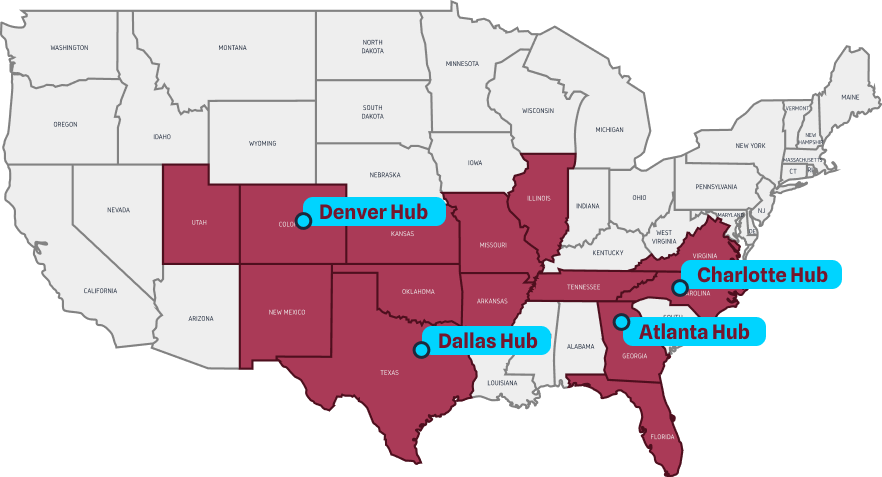
across 108 locations, 14 states, inside live carrier environments
Live carrier environments demand zero-error precision. MercuryZ enforced it.
Central offices and carrier facilities operate under strict access protocols and technical standards that leave no room for on-the-job learning. The infrastructure inside these environments is live, interconnected, and load-bearing, meaning a single testing error, a misconfigured circuit, or an improperly handled fiber span has the potential to disrupt service across entire network segments, affecting carriers, enterprise customers, and end users downstream.
MercuryZ set and enforced a non-negotiable deployment standard for this program: every technician placed on-site had verified, documented prior experience inside live carrier environments before they were ever considered for deployment. Credentials were reviewed. Field histories were confirmed. Site-specific access requirements were managed ahead of arrival.
The standard was applied uniformly, across every site, across every state. No exceptions.
Fourteen states, fifteen routes, compressed timelines. MercuryZ held it all together.
Multi-market deployment at this scale is not primarily a sourcing problem, it is an operational one. Managing credentialing pipelines, travel logistics, site scheduling, personnel coordination, documentation protocols, and real-time issue resolution across 108 distributed infrastructure sites is a continuous operational challenge that cannot be solved by assembling a list of available contractors.
MercuryZ maintained centralized operational oversight across the full 14-state deployment footprint from day one. Site schedules were coordinated and monitored continuously. Documentation quality was reviewed against defined standards at each location. When personnel issues arose, as they inevitably do at scale, replacements were sourced directly from the same pre-qualified national network and positioned without disrupting the broader program timeline or creating gaps in site coverage.
The program did not slow down. It did not pause. It executed.
Incomplete fiber records blocked network capacity planning. MercuryZ resolved it.
The client’s fiber records required comprehensive field validation before next-generation capacity planning could move forward with confidence. Years of network upgrades, equipment decommissions, route changes, and infrastructure modifications meant the existing documentation needed to be verified against actual field conditions. For a carrier preparing to expand bandwidth capacity at scale, establishing an accurate, field-verified record of the physical infrastructure was not optional, it was the foundation the expansion plan depended on.
MercuryZ technicians did not simply confirm site access and move on. They operated under structured reporting protocols designed specifically to surface discrepancies between documented and field-verified infrastructure states. Fiber span conditions, connection counts, circuit activity verification, and anomalies were captured, documented, and delivered through a structured reporting framework that translated raw field data into actionable infrastructure intelligence.
The result was structured, field-verified infrastructure data, covering fiber span conditions, connection counts, and anomalies across each audited site, delivered in a reporting format that gave network engineers reliable, actionable intelligence for bandwidth planning and capacity decisions.
The first program established both the operational model and the performance benchmark. MercuryZ deployed 20 specialized field professionals across 108 distributed infrastructure sites spanning 10 long-haul fiber routes in 14 states, a deployment footprint that required simultaneous execution across geographically dispersed markets without any degradation in technical quality, documentation accuracy, or site performance.
More than 70,000 individual fiber connections were audited across the program. Each audit was performed under the same documentation standard and field verification protocol, regardless of site complexity, access requirements, or geographic location.
Program 1 spanned 9 weeks. Average time from purchase order to completed site audit: 22 days (per PO, specific to each fiber route).
That pace, 22 days from purchase order to completed site audit per route, across 108 locations, 14 states, inside live carrier environments, is not a standard industry outcome. It is the direct result of a pre-built national deployment infrastructure, a pre-qualified workforce network, and operational processes engineered specifically for speed-without-compromise execution.
The decision to return did not require a competitive evaluation. It was an operational judgment grounded in demonstrated, documented performance. Program 1 had proven the model. Program 2 expanded it.
The second program added 55 sites, 5 additional long-haul fiber routes, and has surpassed 41,000 fiber connections audited to date, with the program still active. The scope expansion was not incremental. It was a direct reflection of the client’s confidence in MercuryZ’s ability to absorb increased program complexity without a reduction in execution quality or timeline performance.
Several technicians from the original 2024 deployment were specifically reactivated for Program 2. Their familiarity with the client’s infrastructure environment, documentation standards, and site access protocols provided immediate operational continuity and compressed the ramp-up cycle that a new deployment team would have required. The workforce infrastructure does not reset between programs, it carries forward
A third national expansion phase is already in active planning, not as a prospect, but as a confirmed next step in an ongoing operational infrastructure relationship.
Three consecutive programs across a multi-year engagement window are not a byproduct of competitive pricing or contract terms. They are the outcome of an execution record that gave the client no reason to look elsewhere.
Multi-state technician deployment, rapid mobilization across 14 states, 108 sites, 9-week execution window.
Sites Audited (Phase 1)
Circuits Audited
Field Resources Deployed
20 Technicians + 10 Support
Avg PO-to-Completion
Avg Site Audit Duration
Program 1 Duration
108 Sites · 70,000+ Circuits · 49-Day Window · 30 Field Resources · 22-Day Avg PO-to-Done

6 directional long-haul routes across critical network corridors, multi-state fiber audit and verification
Fibers Audited
Network Sites Audited
Long-Haul Routes
Coverage
Critical Network Corridors
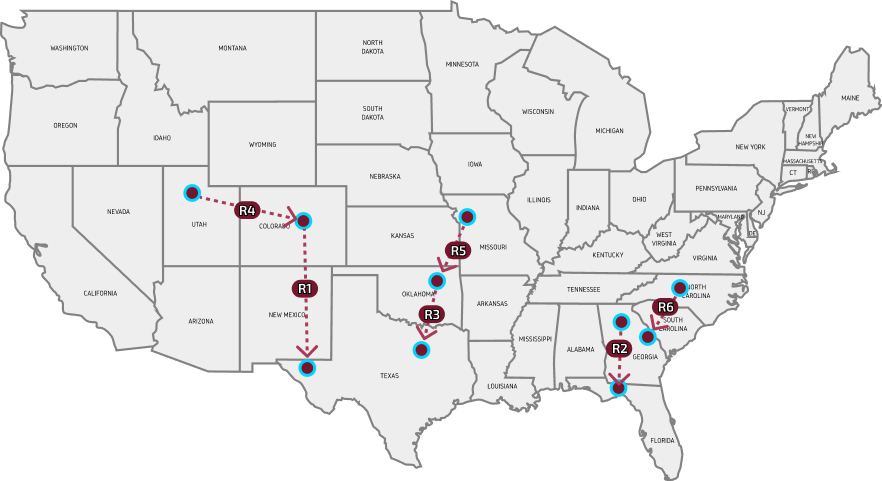
41,000+ Fibers · 55 Network Sites · 6 RoutesMulti-State · Critical Network Corridors

Across two completed and active programs, the results represent a consistent operational track record, not an isolated outcome.
Fiber Connections Audited
Programs 1 & 2 combined
Sites Validated
108 (P1) + 55 (P2)
Long-Haul Routes Supported
10 (P1) + 5 additional (P2)
Avg PO-to-Site Completion
20 Technicians + 10 Support
States Covered
Program 1 Duration
Consecutive Programs Awarded
2024 · 2026 · 2027 (planned)
111,000+ fiber connections audited across two national programs
163 distributed infrastructure sites validated
14-state simultaneous deployment footprint maintained
15 long-haul fiber routes supported across both programs
20 specialized telecom field technicians deployed in Program 1
49-day total delivery window for Program 1
22-day average from purchase order to completed site audit
Second phase was subsequently awarded following Program 1 completion
Original technicians specifically requested by name for Program 2
Third program confirmed and in active planning for 2027
“They were most pleased with the quick turnaround times that we had and our ability to tackle the amount of work they had in a short period of time. They called us for the second round pretty quickly.”
“You responded very quickly with the right people in a very short turnaround, and we got the project off the ground and completed successfully.”
The client returned. Not once, but twice. Original personnel were specifically requested by name. Deployment scope expanded across each successive program. A third national phase is confirmed and already in active planning for 2027.
“This engagement moved from a workforce deployment project into a long-term infrastructure relationship because MercuryZ executed what no conventional provider could, precision workforce deployment at national scale, inside mission-critical carrier environments, under timelines the industry did not expect anyone to meet.”
That trajectory, from a single program to a multi-year, multi-phase operational infrastructure partnership, does not happen by accident. It happens when a partner consistently delivers what they commit to: the right people, in the right locations, operating to the right standard, on the timelines the program requires.
Whether you’re scaling fast or filling a critical gap, we have the workforce to match the moment.