
Every large infrastructure build eventually hits the same constraint: not enough qualified hands within driving distance to execute the schedule. Data centers, fiber networks, substations, and advanced manufacturing facilities are landing in markets that were never designed to staff them. When that happens, the question isn’t whether you’ll pay a premium for labor — it’s whether you’ll pay a predictable, bounded one to bring skilled people in, or an open-ended one as your calendar slides.
The operators who finish on time have stopped treating traveling technicians as a last resort. They treat them as a planned capacity layer — deployed deliberately, managed professionally, and demobilized cleanly when the phase is done.
Sources: Associated Builders and Contractors, Jan 2025; NCCER / AGC 2025 Workforce Survey.
What Happens When a Local Labor Market Runs Dry
Picture a hyperscale data center breaking ground in a mid-sized market. On paper, the region has electricians, fiber technicians, and HVAC crews. In practice, a single build of that size can absorb the qualified, available portion of the local workforce almost immediately — and every other contractor in a hundred-mile radius is competing for the same people at the same time.
What follows is predictable. Wages spike as crews get poached mid-project. Sub-tier trades — controls, testing and commissioning, specialized fiber splicing — don’t exist locally at the required volume. The shortage isn’t only a headcount problem. According to the NCCER / AGC 2025 workforce survey, 57% of firms cite a lack of skills or qualifications and 41% cite missing credentials. You’re not just short on bodies — you’re short on the right bodies.
The demand shock lands hardest in smaller markets, precisely where the megaprojects are being built. Broadband expansion under BEAD’s $42.45B federal program is deploying crews into rural and underserved regions that have never seen this kind of build volume. The projects arrive before the workforce infrastructure exists to support them.
Net new construction workers the industry must attract
Source: Associated Builders and Contractors (ABC), official release, Jan 24, 2025.
Share of construction firms reporting each condition
Source: NCCER / AGC 2025 Workforce Survey. Reported conditions among U.S. construction firms across all sectors.
When Should You Look Outside Your Local Market?
Not every project requires traveling talent, and bringing crews in too early adds cost without value. The signal to widen your search isn’t a gut feeling — it’s a set of concrete conditions. If two or more of these apply, the local market is already telling you it can’t carry the schedule.
✓
✓
✓
✓
✓
When the checklist lights up, the answer is not to keep reposting the same job in the same market. It’s to expand the geography of your labor pool deliberately — and to work with a partner who already knows how to move skilled people into a region and keep them productive.
How the Traveling-Tech Model Works
A traveling technician is a fully qualified tradesperson who relocates temporarily to where the work is — for the duration of a phase, a milestone, or a full build. Done well, this isn’t a scramble of scattered contractors. It’s a managed pipeline that behaves like an extension of your own crew.
Scope & Match
Define the trades, certifications, headcount curve, and timeline — then match vetted, credential-verified technicians to the exact requirement.
Mobilize
Travel, lodging, per diem, and site logistics arranged before departure — so technicians arrive ready to badge in, not sorting out where they’re sleeping.
Deploy & Support
Crews work under clear site leadership. Timekeeping, compliance, and multi-state regulatory requirements are handled behind the scenes.
Scale & Demobilize
Ramp headcount up or down with the schedule, then demobilize cleanly — no idle payroll, no loose ends, no lingering obligations.

What Traveling Techs Are Actually Looking For
The best field technicians have options. If you want the strong ones to show up — and to stay through demobilization rather than leave for the next project two states over — the model has to address what actually keeps them on site. Competitive pay is the starting point, but it’s rarely the deciding factor.
Reliable, worth-it compensation
Competitive pay plus per diem that genuinely covers being away from home. The premium is expected — but it has to be accurate and on time.
Logistics handled for them
Housing, travel, and per diem sorted before they arrive. Techs who spend their first two days hunting for accommodation don’t come back for the next deployment.
Steady, well-run work
A clear scope, real hours, and a site that’s ready for them. Nothing burns goodwill faster than traveling across the country to stand around waiting.
Respect and a next engagement
To be treated as a skilled professional, paid without drama, and offered the next deployment. Reputation is how you build a bench that travels back.
Most of that list is logistics and trust, not just the rate. That’s exactly where ad-hoc traveling arrangements fall apart — and where a managed deployment earns its value.
Why Managed Logistics Matter to the Client
Anyone can post a job listing for out-of-town labor. The hard part is everything around the work: verifying credentials before boots hit the ground, moving dozens of people into a market with no housing slack, keeping them compliant across state lines, and replacing a no-show before it costs you a shift. Handle those badly and traveling labor becomes a liability. Handle them well and it becomes your most flexible capacity.
An experienced partner managing the deployment absorbs the operational risk that would otherwise land on your superintendent’s desk. Credential verification, travel and lodging coordination, per diem administration, timekeeping, multi-state compliance, and rapid backfill stop being your problem and become a managed service with a single point of accountability.
That’s the real product — not “warm bodies,” but a predictable, productive crew that shows up ready, stays through the phase, and scales with your schedule while someone else handles the logistical details that decide whether it works.
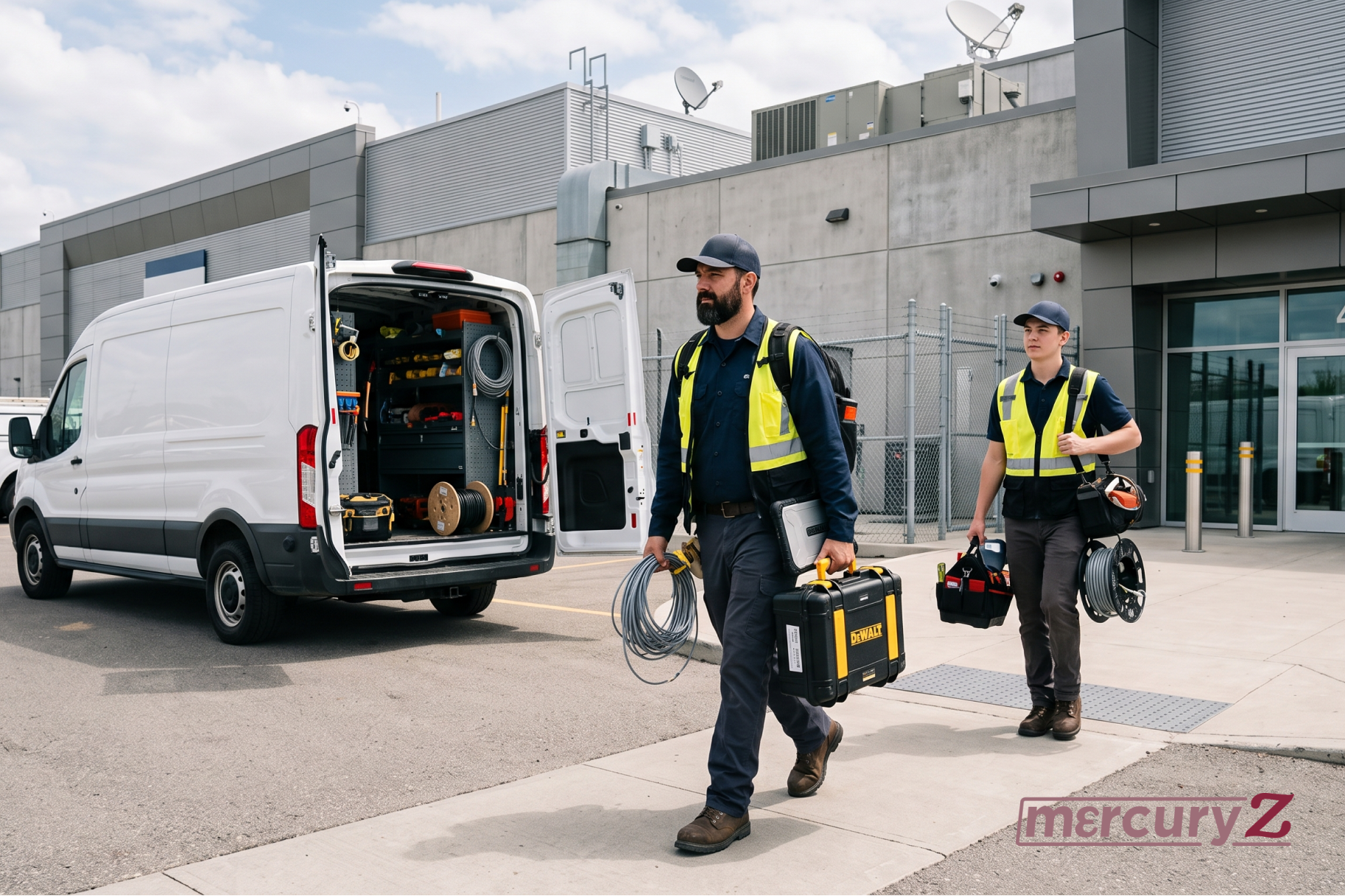
Costlier Labor, Cheaper Delay
Traveling talent typically costs more per hour than local labor. Travel, lodging, and per diem add to the wage. That’s real, and it’s worth being clear-eyed about. But that premium is almost always a fraction of the cost of a facility that opens months late.
Higher hourly rate + travel, lodging & per diem. A one-time, bounded, plannable cost. You know it before you mobilize, and it ends when the crew demobilizes.
Deferred revenue, contractual penalties, extended financing, and idle downstream trades — an open-ended cost that compounds every week the building sits dark.
The framing that matters for leadership: the labor premium is a line item you can size and cap before mobilization. Schedule slip is a risk that grows the longer the project stalls. For a revenue-generating facility — a data center hall going live, a fiber network activating its first subscribers — the arithmetic rarely favors waiting for the local market to recover.
18 Years Moving Skilled People to Where the Work Is
Mercury Z is in its 18th year supporting client needs across infrastructure markets — and specifically in the logistics of deploying traveling technical talent. When your local bench runs dry, Mercury Z handles the sourcing, credentialing, travel, lodging, per diem, and compliance so your team can stay focused on the build.
The goal is straightforward: keep your schedule intact when the labor market says it can’t be done. Whether the project is a fiber construction program, a data center buildout, a substation expansion, or a BEAD-funded broadband deployment — the model is the same. Bring the right people to the work, manage them professionally, and demobilize cleanly when the phase is complete.
Strategic Takeaways
- Local labor markets in major infrastructure build zones are structurally undersupplied — the shortfall grows year over year, and the projects landing in these markets won’t wait for the workforce pipeline to catch up.
- The signal to widen your labor search is a set of concrete conditions, not a feeling — ramp exceeding local supply, specialty trades unavailable, credentials as the bottleneck, or severe delay cost if the schedule slips.
- A managed traveling-tech deployment is a planned capacity lever, not a scramble — structured in four stages and operated with a single point of accountability for logistics, compliance, and performance.
- The labor premium for traveling talent is real, bounded, and plannable. The cost of schedule delay is open-ended and compounds. For revenue-generating facilities, the comparison almost always favors bringing people in.
- What keeps strong technicians on site isn’t just the rate — it’s logistics handled in advance, steady organized work, and professional treatment that makes them willing to travel for you again.
Sources
- Associated Builders and Contractors (ABC). Construction Industry Must Attract 439,000 Workers in 2025. Official release, January 24, 2025. abc.org
- NCCER / AGC. 2025 Workforce Survey. 92% of firms report difficulty hiring; 57% cite lack of skills or qualifications; 45% say shortages caused project delays; 41% cite missing credentials. nccer.org
- NTIA. Broadband Equity, Access & Deployment (BEAD) Program. $42.45 billion federal broadband deployment program. ntia.gov
- U.S. Bureau of Labor Statistics. Occupational Outlook Handbook — Electricians. Employment projected to grow 9% from 2024–2034. bls.gov