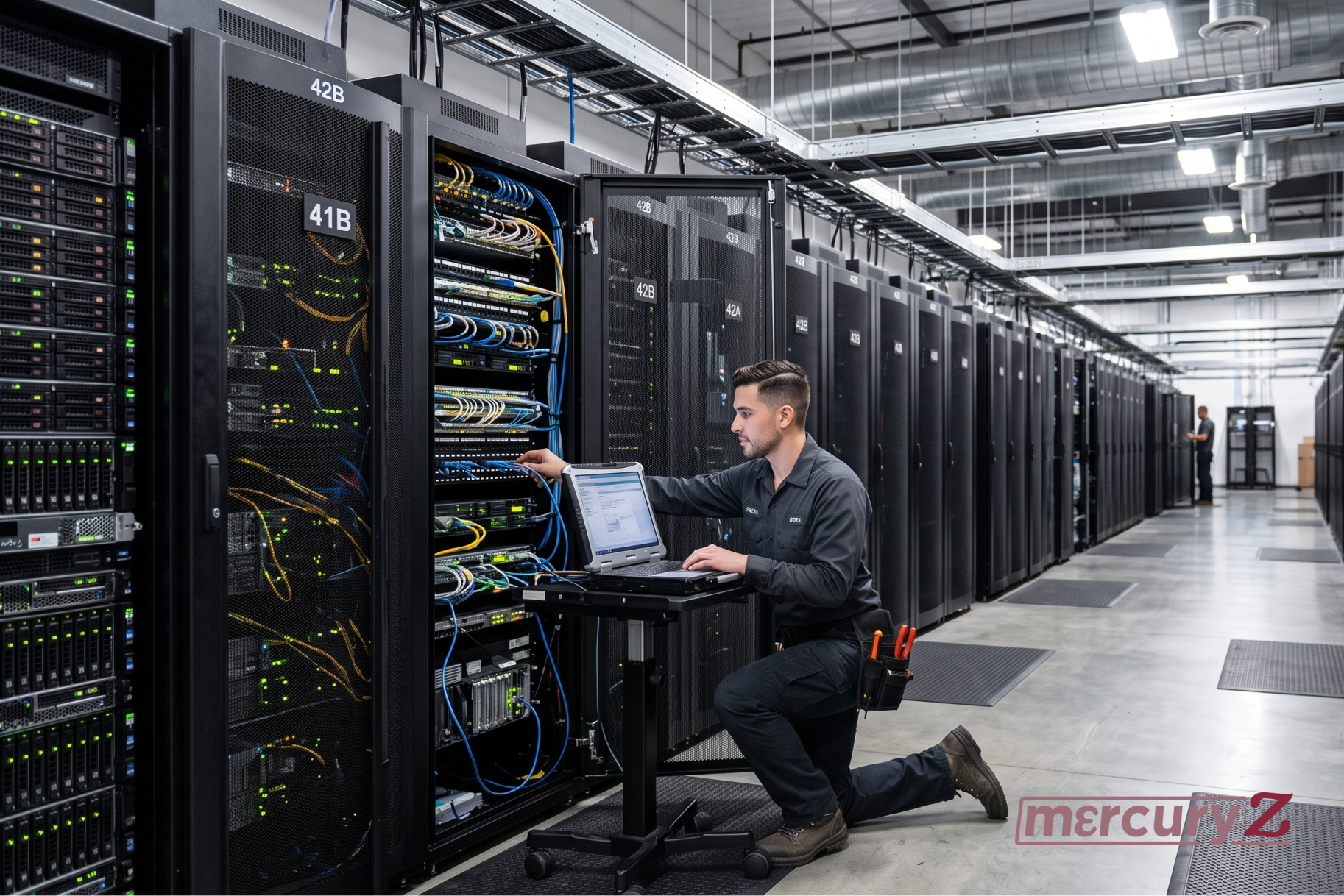
Everyone is talking about the AI-driven data center buildout. Hyperscalers are announcing billion-dollar campuses. Secondary markets are suddenly on the map. Real estate developers are converting industrial sites overnight.
What doesn’t get talked about nearly as much: none of it gets built without the people on the floor.
Rack-and-stack crews. Cable technicians. Low-voltage electricians. Network engineers who can terminate a fiber run, configure a switch, and hand a clean site to the cloud team by end of shift. These are the professionals making the AI infrastructure revolution physically real and right now, they’re in higher demand than the market has seen in years.
Sources: Dodge Construction Network 2025; IEA 2026 Electricity Report; Mercury Z deployment data.
The Scale of What’s Being Built
Let’s put some numbers on this.
According to the 2025 Dodge Construction Network report, data center construction starts in the U.S. hit a record high, with more than $40 billion in new projects underway or planned. That’s not just the headline coastal markets. It’s Birmingham, Huntsville, Montgomery. It’s the Midwest. It’s secondary markets that suddenly have the power infrastructure, land costs, and tax incentives to attract enterprise-grade facilities.
The drivers are straightforward: AI model training and inference requires enormous compute capacity, and that compute lives in physical data centers. The hyperscalers, AWS, Google, Microsoft, Meta are all expanding simultaneously. Telecom carriers are upgrading edge data centers to support 5G and edge compute workloads. And colocation providers are racing to keep up with demand.
The IEA estimated in its 2026 report that data center electricity consumption could double by 2030. That’s not an abstract projection, it’s already showing up in construction pipelines, RFQ activity, and workforce shortages.
Projected data center power demand growth through 2030
Source: IEA Electricity 2026 Report. Projected data center electricity consumption globally.
What “Skilled Field Tech” Actually Means in a Data Center Build
There’s a persistent misconception that data center work is primarily an IT job, something done remotely, by engineers in air-conditioned offices. The physical reality is completely different.
Before a rack serves a single workload, a team of skilled field professionals has to:
Survey and prepare the space.
This includes floor plans, cable pathway design, raised floor or overhead tray routing, and power distribution verification. None of this happens on a laptop in another state.
Rack and stack hardware.
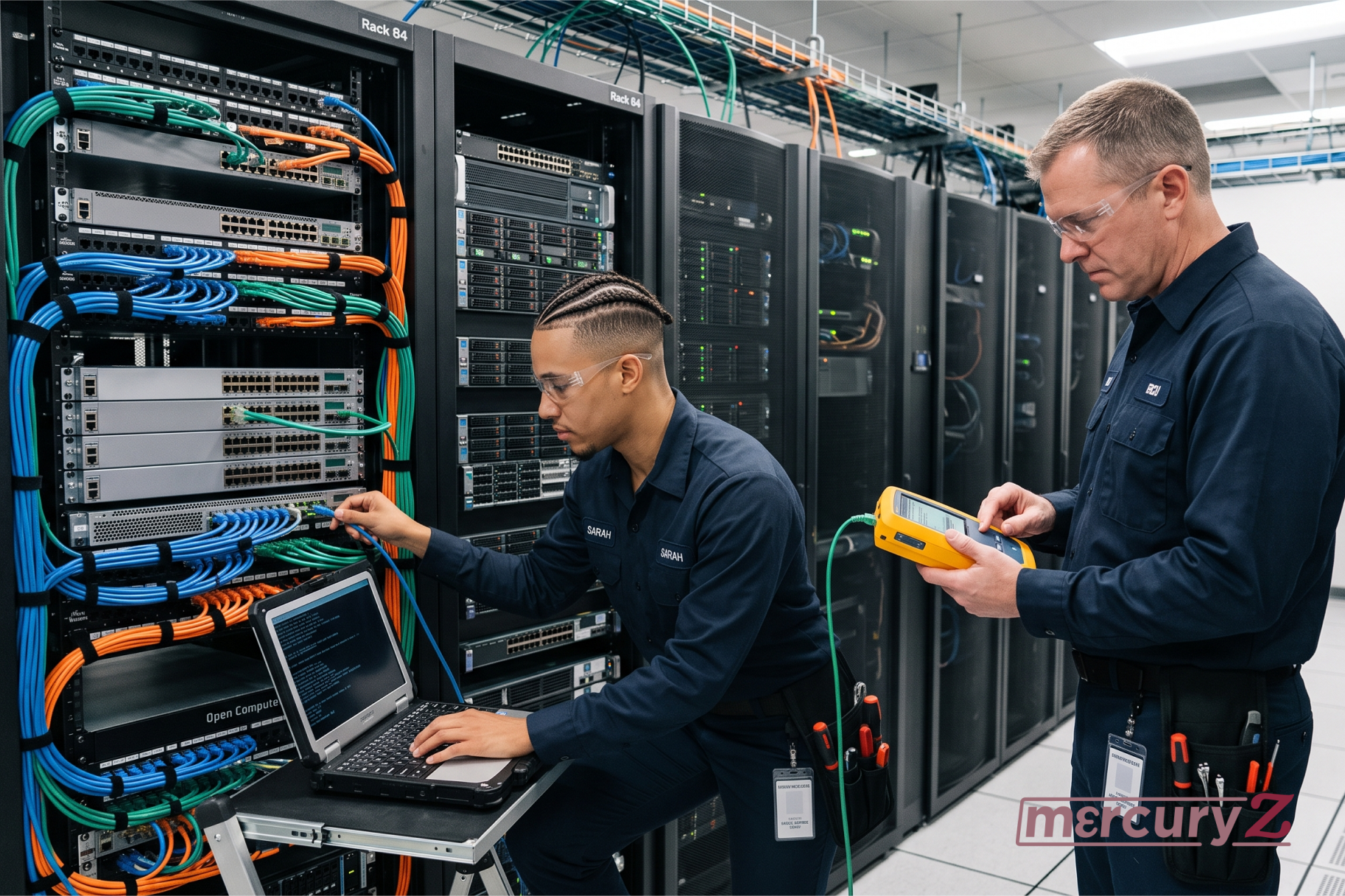
Physical installation of servers, switches, patch panels, PDUs, and cable management systems. Precise work, often under time pressure, often with millions of dollars of hardware being handled.
Run structured cabling.
Fiber runs, copper runs, cable termination, testing, and labeling to spec. In a Tier 3 or Tier 4 facility, structured cabling must meet strict standards, a bad termination doesn’t get you a mulligan.
Low-voltage and electrical work.
Data centers run at 400V+ in many modern facilities. The electricians and low-voltage specialists who work these jobs need proper credentials and experience.
Configure and commission.
Once the physical infrastructure is in place, network technicians bring it online configuring switches, verifying connectivity, running acceptance tests.
Documentation.
As-built drawings, rack elevations, cable labeling, test results. Without it, the facility team can’t maintain what you built.
Every one of these steps requires people who know what they’re doing. You can’t automate a fiber termination. You can’t outsource rack-and-stack to a chatbot.
Secondary Markets Are Where the Opportunity Is Biggest
The hyperscaler campuses in Northern Virginia and Phoenix get the headlines. But the most interesting workforce opportunity right now is in the secondary markets where the next wave of capacity is being built.
Places like:
⬥
Huntsville, AL — Defense infrastructure, DoD data center expansion, strong power grid
⬥
Birmingham, AL — Lower land costs, growing industrial base, proximity to Atlanta without Atlanta prices
⬥
Montgomery, AL — State government tech investment, Mercedes-Benz manufacturing infrastructure spillover
⬥
Midwest secondary markets — Columbus OH, Indianapolis IN, Des Moines IA — all seeing significant data center investment driven by available land, renewable energy, and favorable tax treatment
For Mercury Z, these are exactly the markets we operate in. And the pattern is consistent: where a major data center project is announced, a cluster of field tech demand follows and stays for 12–24 months through the construction and commissioning phases.
The challenge for most field technicians is mobility. These projects are where the work is, and being willing to travel, with the per diem economics that traveling tech work provides puts skilled professionals in a very different position than those anchored to a single market.
The Economics of Being a Traveling Data Center Tech
Here’s what the financial picture actually looks like for a skilled field tech willing to travel.
A network technician or rack-and-stack specialist working on data center projects in secondary markets can typically earn:
⬥
Base hourly rate: $32–$52/hour depending on certifications and specialty
⬥
Per diem: $75–$100/day tax-free (housing + meals)
⬥
Over a 26-week deployment: $14,000–$18,200 in per diem alone — tax-free
That per diem income is the number most people in the industry still underestimate. It doesn’t count toward your taxable income the same way wages do. Over a full year of traveling work, a technician can receive $28,000–$36,000 in per diem, money that doesn’t trigger the same tax burden as an equivalent salary increase would.
The result: a traveling data center tech earning $42/hour with $90/day per diem is in a materially better financial position than a locally-anchored tech earning $50/hour with no per diem even before accounting for overtime, certifications, or career progression.
What Mercury Z Is Doing About the Workforce Gap
Mercury Z built its model specifically around this dynamic. Field techs who want to work on significant infrastructure projects data centers, carrier networks, stadium deployments shouldn’t have to navigate a fragmented placement market to find the next good contract.
Our platform connects credentialed technicians with the data center projects, carrier deployments, and commercial construction engagements that need them. We manage per diem, travel logistics, and compliance so technicians can focus on the work.
For GCs and data center operators, Mercury Z offers a managed field workforce that can staff up for a project, execute to spec, and document properly. One point of contact, vetted technicians, performance accountability.
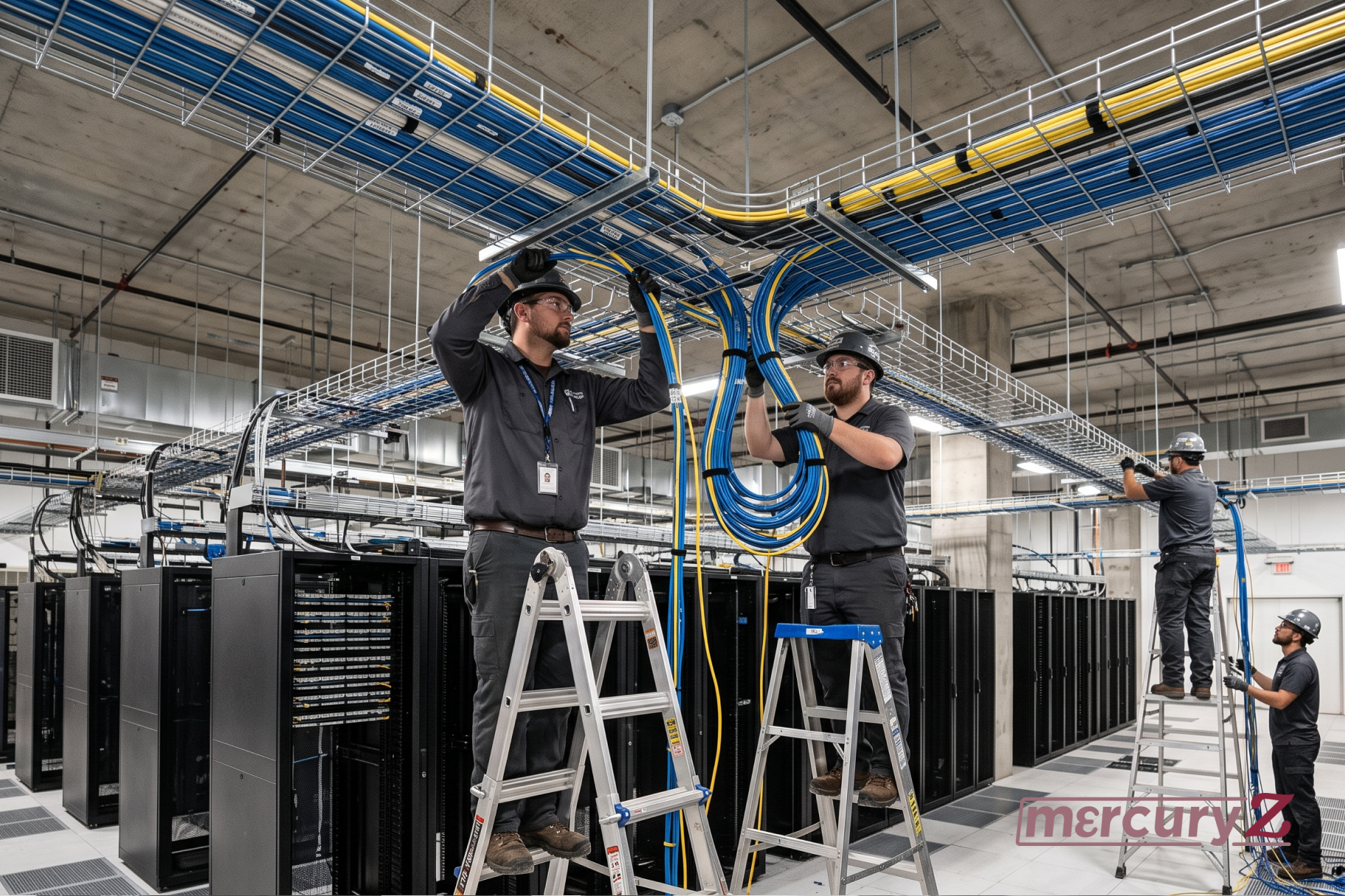 A Mercury Z crew routes structured cabling through overhead trays in a newly constructed data center facility — one of the most critical and time-sensitive phases of any build.
What to Do If You’re a Field Tech Right Now
If you have structured cabling, low-voltage, network, or electrical credentials and you’re willing to travel the data center boom is one of the best labor markets you’ll see in your career.
The window is open. Data center construction typically runs 18–36 months from groundbreaking to commissioning. Secondary market projects are ramping now, and the demand for experienced field techs in those markets will sustain through at least 2027.
Mercury Z is actively deploying teams in data center markets across Alabama, Texas, Indiana, Louisiana, Nevada, and expanding.
If you’re ready to put your credentials to work on the projects that matter: visit jobs.mercuryz.com and apply today.
Mercury Z is a field operations partner specializing in data center infrastructure, carrier network deployments, and Starlink Business installations. We serve enterprise clients and GCs across 29+ markets. Visit jobs.mercuryz.com.
Sources
-
- Dodge Construction Network. 2025 Data Center Construction Report. Record high in U.S. data center construction starts, more than $40 billion in new projects underway or planned. construction.com
- International Energy Agency (IEA). Electricity 2026. Data center electricity consumption projected to double by 2030. iea.org
- U.S. Bureau of Labor Statistics. Occupational Outlook Handbook. Employment projections for network technicians and electricians. bls.gov