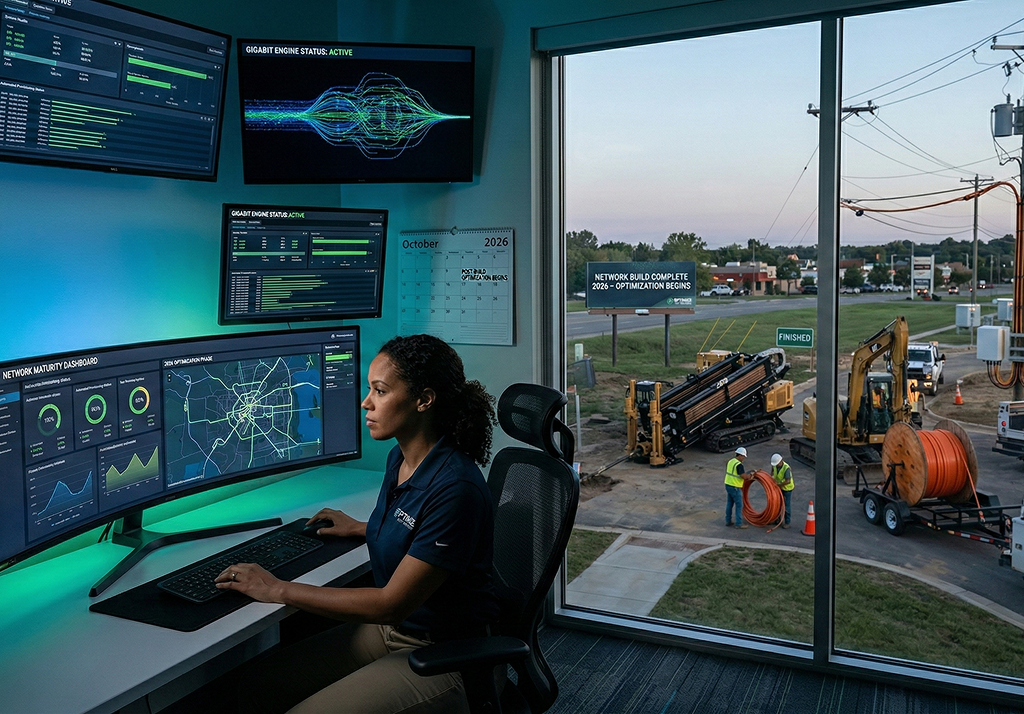
For the last several years, the telecommunications industry has been defined by the “Great Build-Out.” High-visibility construction crews, massive rolls of orange conduit, and the frantic race for fiber-to-the-home (FTTH) have dominated executive agendas and capital expenditure reports across the globe. Specifically, this era of physical expansion was driven by a singular goal: to plant the flag and claim territory in the high-speed race. However, as the dust finally settles and the physical glass reaches maturity in market after market, a sobering question emerges for leadership: What happens when the construction trucks leave?
Ultimately, the completion of a physical network is not the finish line—it is merely the starting block for a much more complex race. Consequently, once the hardware is in the ground, the challenge shifts from the external physical world to the internal digital stack. To maintain a competitive edge and ensure long-term viability, providers must now pivot their capital and operational focus toward network infrastructure optimization. In doing so, this transition ensures that the digital backbone is every bit as robust, agile, and scalable as the physical fiber it supports, effectively turning a simple connection into a high-performance engine.
The Strategic Shift Toward Network Infrastructure Optimization
1. Automation as a Pillar of Optimization
In a post-build-out world, manual configuration is a liability. Furthermore, modern networks are becoming too complex for human-only oversight. As a result, the shift toward AIOps (Artificial Intelligence for IT Operations) allows networks to become self-healing, which is a critical component of modern network infrastructure optimization.
- Zero-Touch Provisioning (ZTP): For instance, when a new customer signs up, the network should provision itself in minutes rather than days.
- Predictive Remediation: Instead of reacting to a “fiber cut,” automated systems use telemetry to reroute traffic around potential bottlenecks before the customer experiences a drop in quality.
2. Cloud Migration and Internal Stack Modernization
While the cables are physical, the intelligence of the network should be virtual. By transitioning internal operations to a hybrid multi-cloud environment, ISPs can scale their back-office and customer-facing applications as fast as their bandwidth.
According to research on cloud migration benefits, moving the internal stack to the cloud reduces capital expenditure (CapEx). Moreover, it replaces it with a predictable operational expense (OpEx) model. Therefore, this agility is essential for any provider seeking long-term network infrastructure optimization.
3. Data Center Support: The New Edge
Similarly, the “Central Office” of yesterday is becoming the “Edge Data Center” of tomorrow. In order to support low-latency applications like autonomous vehicles and AI agents, ISPs must modernize their local data center footprints. Specifically, this involves not just better servers, but advanced specialized cooling services to support high-density AI workloads.
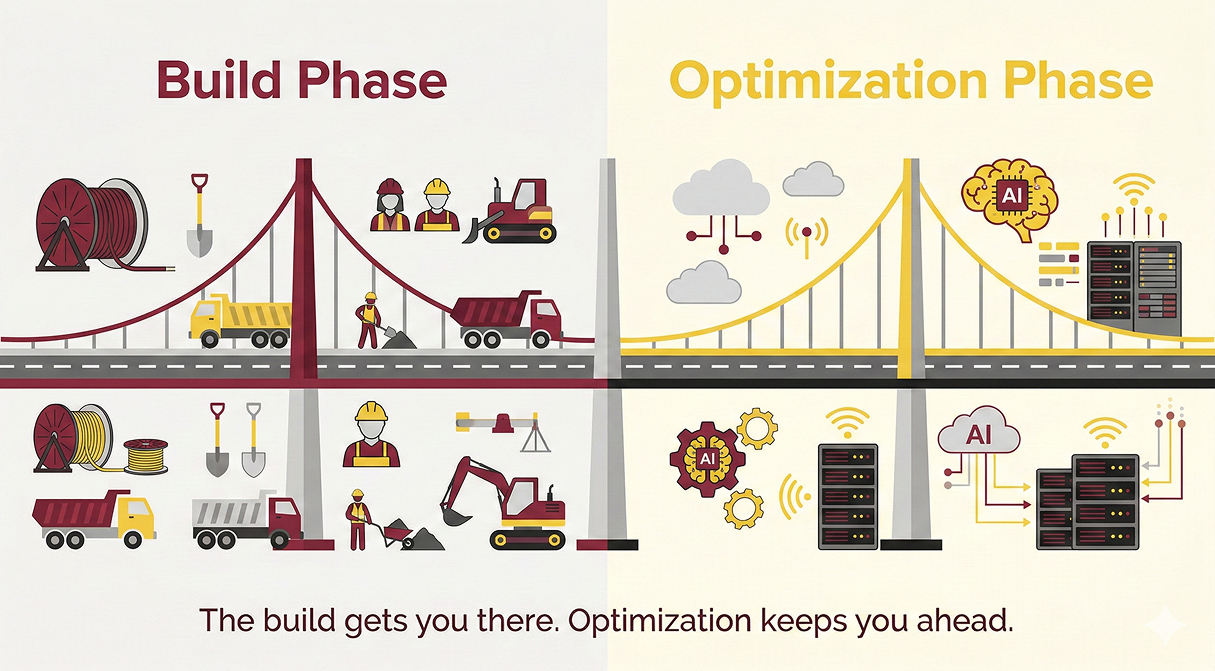
Turning Connectivity into a Technology Platform
When an ISP modernizes its internal stack, it stops being a “utility” and starts being a “technology platform.” This allows for the monetization of the network through Network APIs.
Imagine a world where a gaming company pays for a “Latency-on-Demand” API to ensure its users have a lag-free experience, or a healthcare provider uses a dedicated “Network Slice” for remote surgery. These are not connectivity plays; they are platform plays.
Feature | Legacy ISP Model | Modern Platform Model |
Provisioning | Manual/Ticket-based | Automated/Zero-Touch |
Scaling | Physical Hardware Upgrades | Cloud-Native Virtualization |
Visibility | Reactive Monitoring | Proactive Observability |
Revenue | Per-user Subscription | API Monetization & Value-Add Services |
Mercury Z: Leading the Charge in Network Infrastructure Optimization
As the physical build-out winds down, the focus naturally turns inward. This is precisely where Mercury Z steps in. While many firms focus solely on the “outside plant,” Mercury Z specializes in the Cloud & Data Center services that form the nervous system of a modern ISP.
Admittedly, the transition from “build-out” to network infrastructure optimization is often fraught with technical debt. Indeed, many ISPs find that while their external reach has grown, their internal processes are still stuck in a legacy era. To address this, Mercury Z helps bridge the “scale gap” by:
- Modernizing PoP Infrastructure: First, we ensure your local Points of Presence are equipped for 2026’s AI-driven traffic.
- Cloud Strategy & Implementation: Second, we assist in the migration of legacy OSS/BSS systems to the cloud.
- Engineering Audits: Finally, we use advanced field assessments to identify underutilized resources and eliminate bottlenecks.
In conclusion, Mercury Z doesn’t just help you build the network; we help you evolve into a technology leader. Because when the construction trucks leave, the real work of digital transformation begins.
Ready to Evolve from Pipe Builder to Technology Platform?
Don’t let legacy systems bottleneck your fiber reach. Modernize your OSS/BSS and edge data centers with Mercury Z to ensure your digital infrastructure is as fast as your fiber.