
Most conversations about tech careers focus on the same things: salary bands, benefits, PTO, remote work flexibility. What almost never gets discussed clearly — even by people who’ve done it — is what traveling field tech work actually pays.
Not the headline hourly rate. The full picture.
When you factor in per diem, tax treatment, overtime exposure, and the density of high-value projects in secondary markets, the math changes substantially. And in most cases, a traveling tech position outperforms a comparably-titled fixed-location job by a margin that would surprise most people.
This is the financial case that doesn’t get a clear explanation. Let’s fix that.
The Piece Everyone Skips: Per Diem
Per diem is a tax-advantaged daily allowance that employers provide to cover meals and incidental expenses (M&IE) when employees work away from their tax home. When structured properly under IRS accountable plan rules, per diem is not included in your taxable income.
This is the number that changes the calculation.
The federal government sets per diem rates for continental U.S. markets — and field operations companies routinely pay per diem on top of an already competitive hourly rate for traveling assignments.
Here’s what that means in real terms: per diem income is not equivalent to the same amount in salary. Because salary is taxed at a combined federal/state effective rate, you would need to earn significantly more in gross wages to net the same take-home value as tax-free per diem. That difference compounds across a full year of traveling assignments.
That’s the math most people in the industry either don’t explain or don’t know.
A Side-by-Side Comparison
Take two field network technicians with comparable credentials — both CCNA-certified, both with 5 years of experience.
- Competitive annual salary
- Benefits: health + 401k match
- No per diem
- Competitive hourly rate above fixed-location equivalent
- Per diem on top of wages — tax-free
- Benefits: health included
- Overtime exposure on active builds
The Market Keeps Sending Work to the Right Places
Here’s the other dynamic: the projects that need field techs are not uniformly distributed. They cluster in secondary markets — exactly the markets where traveling tech professionals go.
Why does this matter financially?
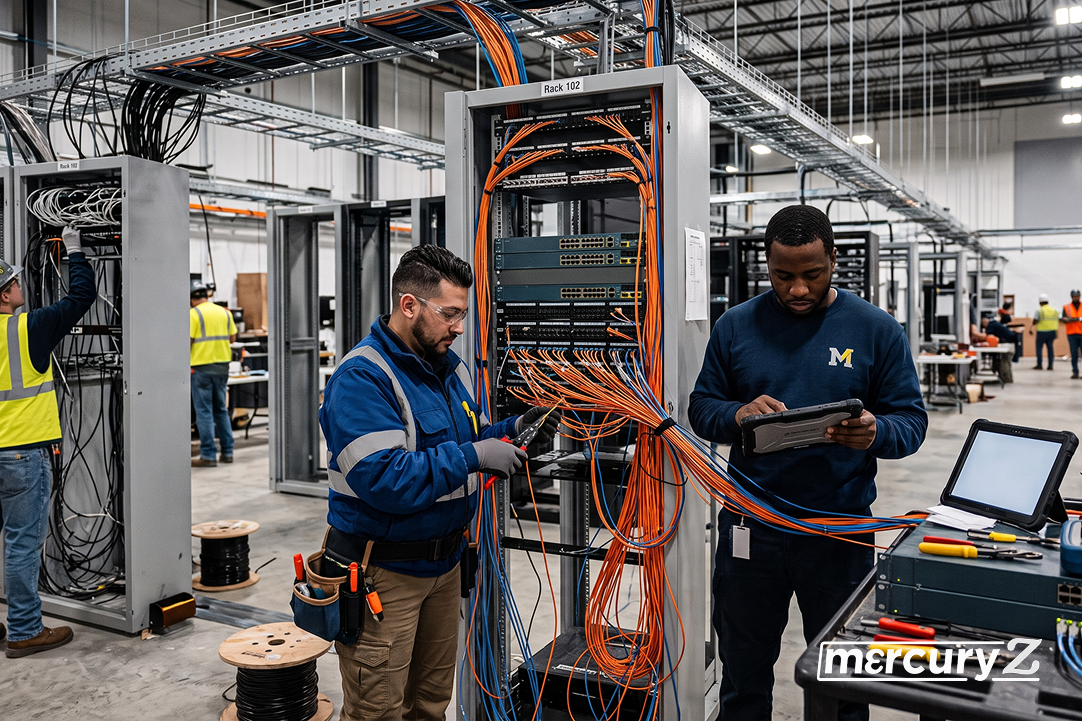
Because when Mercury Z sends a tech to Birmingham for a data center project, that same market often has concurrent demand from a carrier upgrade, a commercial construction project, and a Starlink deployment. The infrastructure investment in a market tends to cascade — utilities upgrade, carriers follow, GCs bring data center work, commercial construction fills in around it.
A traveling tech who knows those markets and has the credentials to work across project types can maintain near-continuous deployment — with per diem running the whole time.
Compare that to a fixed-location tech in a high-cost market who has to compete for the same handful of local contracts and can’t pick up work 40 miles away without it becoming a lifestyle disruption.
The Credential Multiplier
The earning trajectory in traveling tech work compounds differently than it does in fixed roles.
In a fixed corporate IT role, salary bands are often rigid. A 3–5% annual raise is typical. Breaking out of a band usually requires a title change that may or may not align with what’s actually available at a given company.
In traveling field tech work, adding a credential directly unlocks higher-paying project categories. The path looks like this:
| Credential Added | Impact on Earning Potential |
|---|---|
| Starlink Business Certification | Opens satellite deployment project category with premium billing tier |
| BICSI INST1 or INST2 | Qualifies for structured cabling projects with higher rate classification |
| CCNA + network field experience | Significant rate advantage over unlicensed network technicians |
| Journeyman Electrician License | Opens entire category of electrical field work |
| OSHA 30 | Required for many data center / GC projects — table stakes |
Source: Mercury Z field operations data; industry credential rate benchmarks
Each credential opens a category. And because you’re traveling, you’re not competing only for what’s available locally — you can go where that credential type is in demand.
The 4-Year Horizon
Here’s a framing that Mercury Z uses in recruiting because it’s accurate: what does the earning picture look like over 4 years for a traveling tech professional vs. a fixed-location peer?
A traveling tech will accumulate significantly more wealth in 4 years than a peer on a comparable fixed salary, even when the fixed-location peer receives modest annual raises. The combination of a higher effective hourly rate, tax-advantaged per diem, and overtime exposure closes the gap — and often reverses it.
This isn’t theoretical. This is the experience of the technicians on Mercury Z’s active roster.
What It Actually Looks Like in Practice
A realistic traveling tech week on a Mercury Z assignment:
- Monday: Arrive on site. Site survey, equipment check-in, rack layout review.
- Tuesday–Thursday: Active installation work. 9–11 hours/day typical during the build phase.
- Friday: QA, documentation, punch list, sign-off.
- Saturday: Flight home (or extended if back-to-back project weeks).
Per diem runs from travel day through return. Hotels and flights are covered by Mercury Z. Your paycheck covers your actual expenses at home — because your road expenses are covered.
The lifestyle is real. It’s not for everyone. But for a technician who is wired for field work and doesn’t mind travel, the financial case is clear.
 Travel logistics — flights, hotels, and per diem — are handled by Mercury Z, so technicians focus on the work, not the overhead.
The Part Worth Saying Plainly
There’s a version of this career path where a field tech spends 10 years slowly climbing a salary band at a fixed job and wonders why the wealth accumulation isn’t there.
And there’s a version where that same tech, with the same base credentials, spends 4–6 years doing traveling field work — building certifications, accumulating per diem, working on infrastructure projects that matter — and is in a fundamentally different financial position.
Mercury Z exists specifically to make the second path accessible and well-organized for technicians who are ready for it.
The math is on your side. The work is out there. Visit jobs.mercuryz.com to see open field positions across Mercury Z’s markets.
Mercury Z connects certified field technicians with data center, carrier, Starlink, and commercial construction projects across 29+ markets. We handle logistics, compliance, and per diem so you can focus on the work.
Sources
-
- U.S. Internal Revenue Service — Publication 463: Travel, Gift, and Car Expenses. Defines accountable plan rules governing tax-free per diem treatment for employees working away from their tax home. irs.gov
- U.S. General Services Administration — Federal Per Diem Rates. Current M&IE per diem rates for continental U.S. markets used as the baseline for field per diem benchmarks in this article. gsa.gov