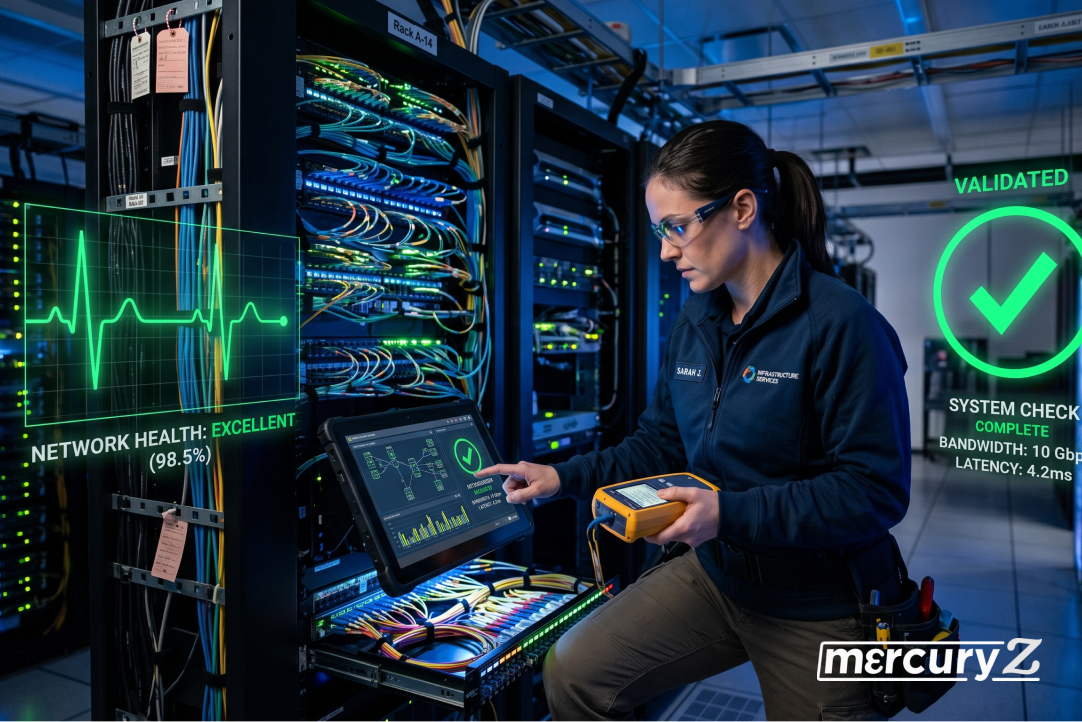
As telecom, hyperscale, and enterprise networks continue to expand, maintaining accuracy between physical infrastructure and digital records has become increasingly complex. Over time, networks evolve through upgrades, mergers, maintenance activities, and emergency restorations. These changes often create inconsistencies between documentation systems and the actual fiber plant. This condition, commonly referred to as network drift, creates operational inefficiencies, delays provisioning, and leads to underutilized infrastructure.
In 2026, this challenge is even more critical. The growth of AI workloads, hyperscale data centers, and high-capacity optical transport requires precise visibility into fiber infrastructure. Without accurate network intelligence, organizations risk overbuilding capacity, misallocating resources, and increasing operational costs. Fiber auditing and network health validation services address these challenges by restoring alignment between physical assets and digital records, enabling operators to maximize return on investment and improve network reliability.
The Impact of Network Drift
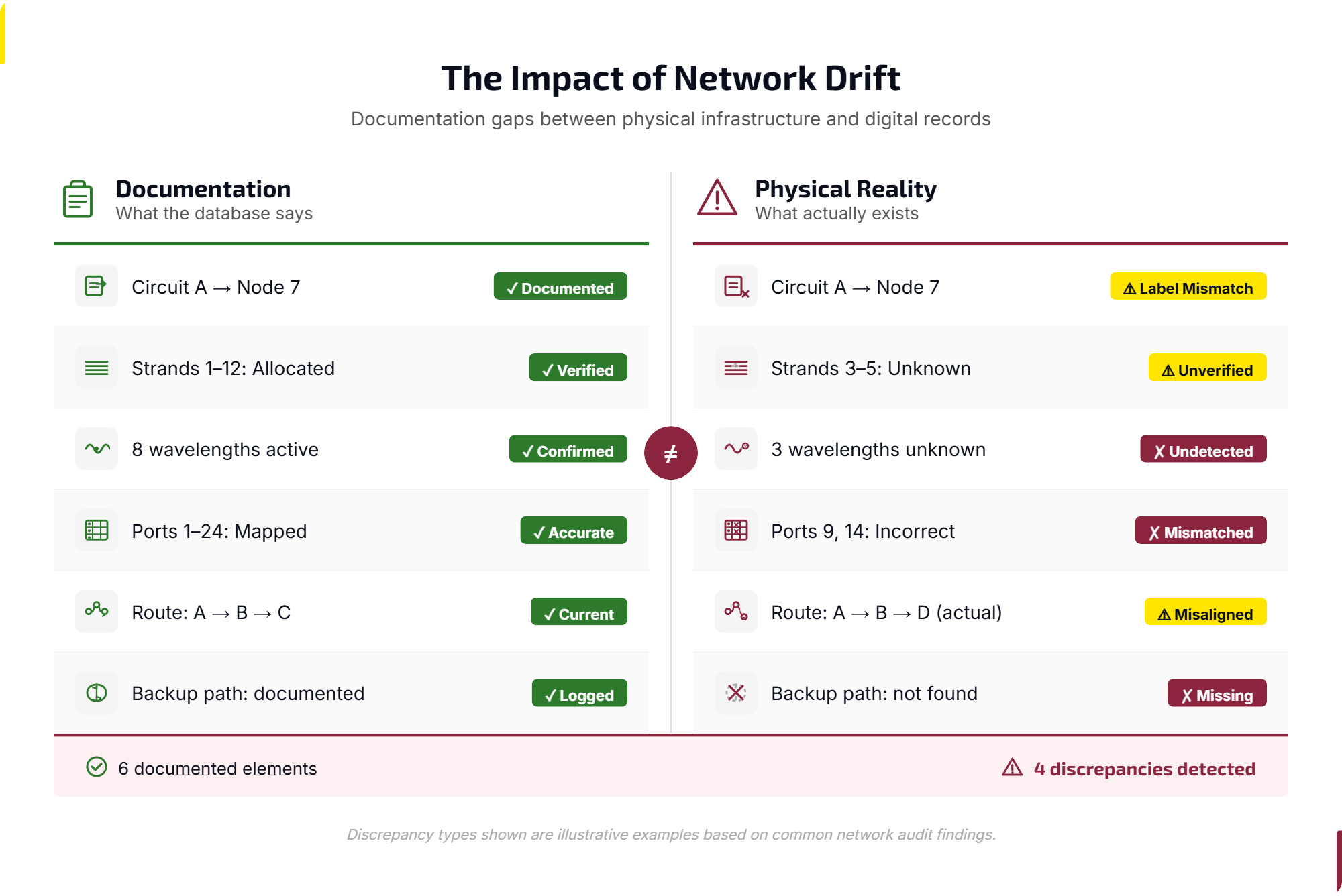
Network drift occurs when infrastructure changes are not properly reflected in operational databases. Large carriers, ISPs, and data center operators often rely on legacy systems that may not accurately track real-time modifications. Over time, documentation gaps accumulate and create multiple operational challenges.
Common issues include:
- Inaccurate circuit documentation and labeling
- Stranded fiber capacity that remains unused
- Unknown or unverified active wavelengths
- Incorrect patch panel records
- Misaligned routing information
- Missing redundancy documentation
These discrepancies slow down service provisioning and increase troubleshooting time. Engineering teams may spend hours verifying circuits that should be immediately identifiable. In many cases, operators deploy new infrastructure because they believe capacity is exhausted, when in reality unused fiber resources already exist.
Non-Invasive Fiber Detection and Validation
Modern fiber auditing techniques allow engineers to validate network activity without disrupting live traffic. Non-invasive detection methods provide safe and efficient visibility into operational networks. These techniques include:
- Live fiber identification to detect optical activity
- Non-intrusive power monitoring through test access points
- Optical signal verification without disconnecting cables
- Visual inspection of patch panels and labeling
- Passive monitoring for wavelength activity
These approaches enable teams to confirm circuit usage while maintaining service continuity. Non-invasive validation is particularly important in data center environments where downtime can result in significant financial impact.
Asset and Inventory Reconciliation
One of the primary objectives of fiber auditing is aligning physical assets with digital records. Inventory reconciliation ensures accurate documentation and improves operational efficiency. During audits, engineers typically verify:
- Fiber strand assignments
- Patch panel labeling accuracy
- Equipment port utilization
- Circuit routing paths
- Redundancy configurations
- Spare capacity availability
This reconciliation process eliminates database inconsistencies and improves network transparency. Once records are corrected, organizations can provision services faster and reduce operational overhead.
Data Center Interconnect Validation
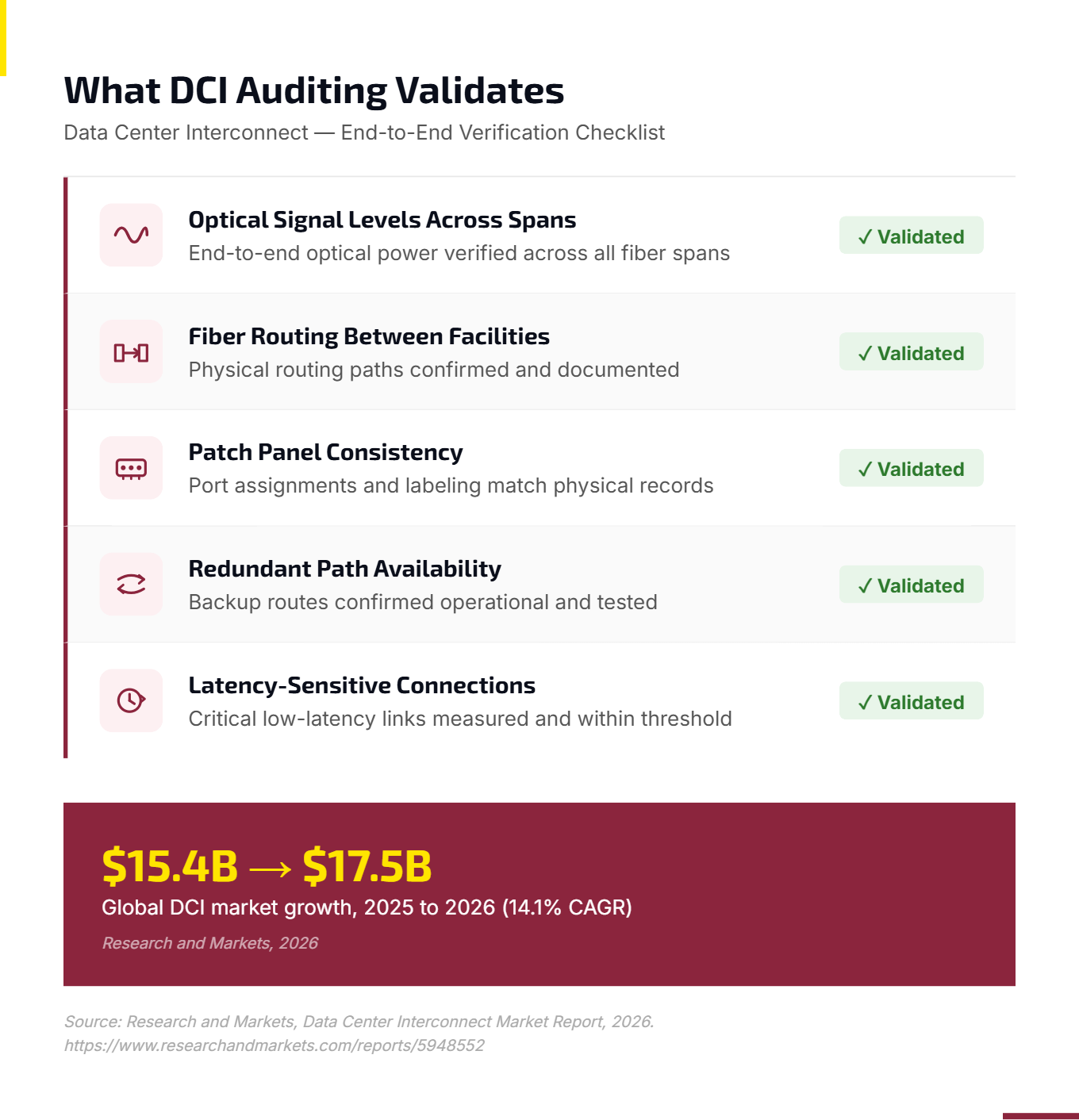
Data center interconnect infrastructure requires precise validation due to high-density connectivity and strict performance requirements. Auditing services for DCI environments focus on verifying end-to-end optical continuity and signal quality. Engineers validate:
- Optical signal levels across spans
- Fiber routing between facilities
- Patch panel consistency
- Redundant path availability
- Latency-sensitive connections
As AI and cloud workloads increase, reliable DCI connectivity becomes essential. Auditing ensures that critical workloads operate without performance degradation.
According to Research and Markets (2026), the global DCI market is projected to grow from $15.4 billion in 2025 to $17.5 billion in 2026, reflecting a 14.1% CAGR — underscoring the scale at which accurate DCI validation is becoming business-critica
Multi-Span Path Analysis
Long-haul and regional networks often span multiple nodes and amplifier sites. Multi-span analysis verifies performance across these complex architectures. This process includes:
- Signal measurement at intermediate nodes
- Amplifier gain validation
- Fiber span continuity checks
- Latency measurement across routes
- End-to-end capacity verification
Multi-span validation ensures that each segment of the network contributes to overall performance and reliability.
Supporting Mergers and Infrastructure Integration
Network audits play a significant role during mergers, acquisitions, and infrastructure integrations. When organizations combine networks, discrepancies between documentation systems can create operational challenges. Fiber auditing helps:
- Validate inherited infrastructure
- Identify duplicate circuits
- Confirm active services
- Align inventory databases
- Establish baseline network documentation
This process accelerates integration timelines and reduces operational risk.
2026 Industry Statistics
The importance of fiber auditing continues to grow as networks scale.
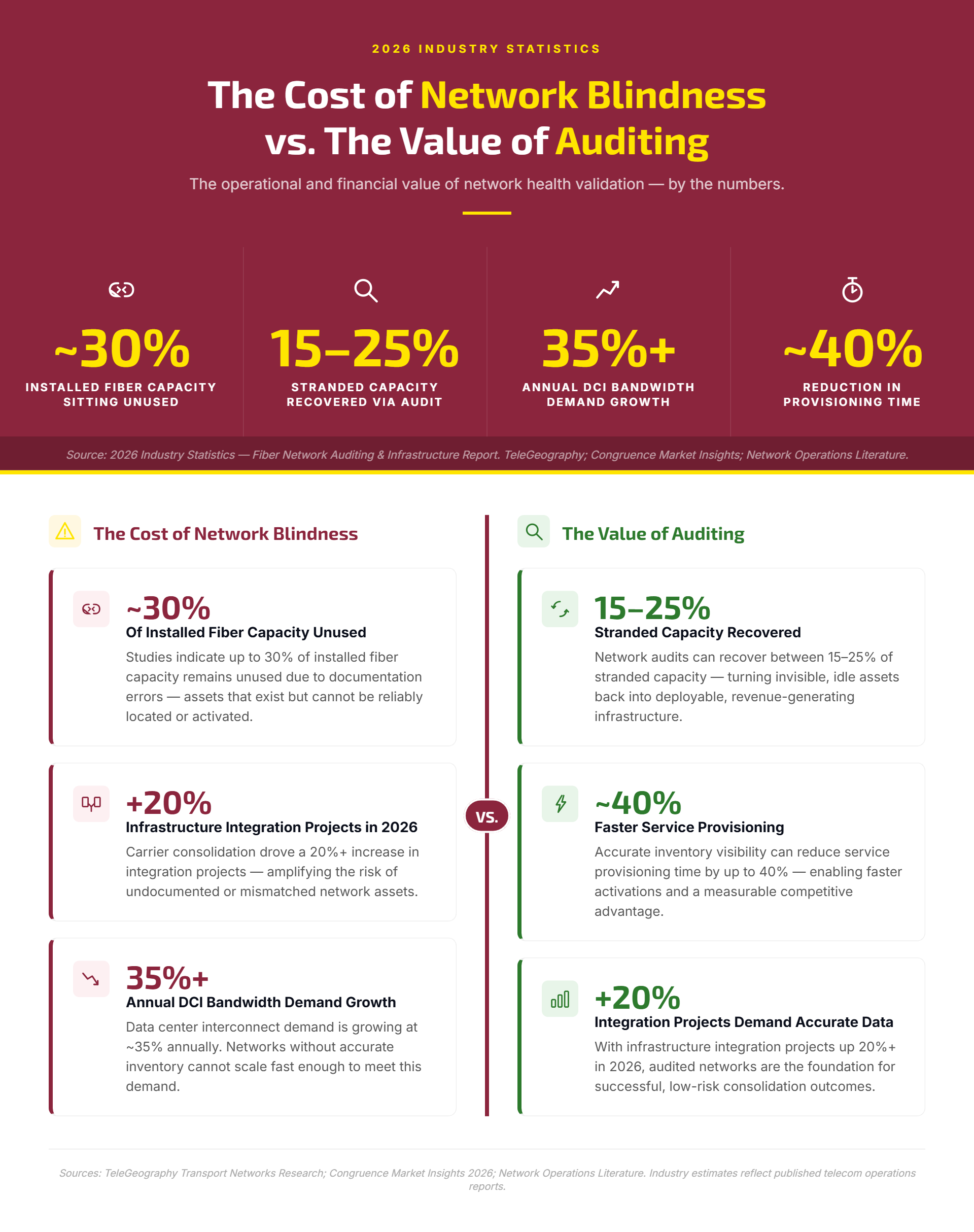
The importance of fiber auditing continues to grow as networks scale. Consider including an infographic in this section highlighting key industry data:
- Studies indicate that up to 30 percent of installed fiber capacity remains unused due to documentation errors
- Network audits can recover between 15 and 25 percent of stranded capacity
- Data center interconnect bandwidth demand is growing at approximately 35 percent annually
- Infrastructure integration projects increased by more than 20 percent in 2026 due to carrier consolidation
- Accurate inventory visibility can reduce service provisioning time by up to 40 percent
These statistics demonstrate the operational and financial value of network health validation.
Operational Benefits of Fiber Auditing
Organization
- Improved service provisioning speed
- Reduced troubleshooting time
- Better capacity planning accuracy
- Lower capital expenditure through optimized utilization
- Enhanced network reliability
These benefits directly impact operational efficiency and customer experience.
Implementation Best Practices
To maximize value, organizations should incorporate fiber auditing into their network lifecycle. Recommended scenarios include:
- Before major capacity upgrades
- During mergers or acquisitions
- After large-scale maintenance activities
- Prior to data center deployments
- During infrastructure modernization initiatives
Regular auditing ensures that documentation remains accurate and supports future planning.
Long-Term Network Visibility Strategy
Beyond one-time audits, operators should adopt continuous validation strategies. Combining periodic audits with automated monitoring improves long-term accuracy. Integrating audit findings into inventory management systems ensures that updates remain synchronized with physical infrastructure.
As networks evolve to support AI, cloud, and edge computing, maintaining accurate fiber visibility becomes essential. Proactive validation prevents operational inefficiencies and supports scalable growth.
Strategic Takeaways
Fiber auditing and network health validation provide the foundation for efficient network operations. By aligning physical infrastructure with digital records, organizations can unlock stranded capacity, reduce operational risk, and improve service delivery. In a landscape where bandwidth demand continues to accelerate — with DCI traffic alone growing over 35% annually — accurate infrastructure visibility is no longer optional. It is a critical component of modern network strategy.