
Optical layer and transport engineering form the technical core of high-capacity fiber networks. As organizations deploy 100G, 400G, and emerging 800G wavelengths, maintaining signal integrity across metro and long-haul spans becomes increasingly complex. High-speed optical transmission is sensitive to attenuation, dispersion, noise accumulation, and nonlinear effects. Without precise engineering, networks may experience degraded performance, reduced reach, and increased error rates.
In 2026, optical transport infrastructure must support AI clusters, hyperscale data center interconnects, and low-latency cloud services. These applications demand consistent, carrier-grade performance across long distances. Optical layer engineering focuses on optimizing signal quality, managing impairments, and ensuring that wavelengths travel efficiently across fiber infrastructure. Through accurate link-budget calculations, impairment mitigation, and amplification strategy design, operators can maximize network capacity while maintaining reliability.
Link Budget and Reach Calculations
Link budget analysis is fundamental to optical transport engineering. It determines whether a signal can travel from transmitter to receiver with sufficient power and quality. Engineers calculate total signal loss across fiber spans, connectors, splices, and optical components.
- Key factors in link budget calculations include:
- Fiber attenuation across distance
- Connector and splice loss
- Passive component insertion loss
- Amplifier gain levels
- Receiver sensitivity requirements
Accurate link budgets ensure that optical signals maintain sufficient power levels while avoiding overload conditions. This process is especially important when deploying high-capacity coherent optics, which have stricter performance thresholds.
Coherent Optics Engineering
Coherent optics enable long-distance, high-capacity transmission using advanced modulation formats and digital signal processing. Engineering coherent systems requires careful planning to ensure optimal performance. Engineers evaluate:
- Modulation format selection
- Baud rate configuration
- Forward error correction requirements
- Optical signal-to-noise ratio thresholds
- Span design for maximum reach
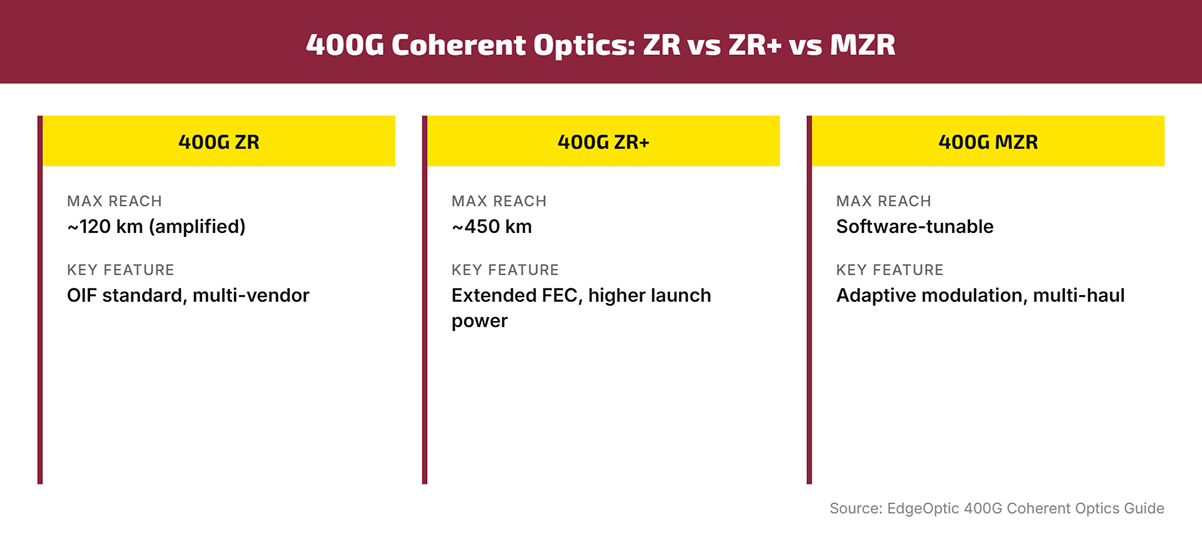
Proper coherent optics engineering allows operators to deploy 400G and 800G wavelengths efficiently. According to the IEEE Communications Society, 400G coherent pluggable modules — including ZR, ZR+, and multi-haul variants — are now the standard architecture for new optical deployments, replacing legacy transponder-based systems and significantly reducing per-bit transport cost.
Optical Signal-to-Noise Ratio Management
Optical signal-to-noise ratio is a critical performance metric. It measures the strength of the optical signal relative to accumulated noise. Poor OSNR can lead to increased bit error rates and reduced reach. Engineers optimize OSNR by:
- Balancing amplifier gain
- Managing span lengths
- Minimizing insertion loss
- Reducing unnecessary optical components
- Implementing power equalization
Maintaining adequate OSNR ensures stable high-speed transmission.
Chromatic Dispersion Compensation
Chromatic dispersion occurs when different wavelengths travel at slightly different speeds, causing pulse spreading. High-speed optical signals are particularly sensitive to this effect. Modern coherent systems use electronic dispersion compensation to mitigate dispersion without additional hardware.
Engineering considerations include:
- Fiber type characteristics
- Span length optimization
- DSP configuration
- Modulation format compatibility
Effective dispersion management improves signal clarity and transmission distance.
Polarization Mode Dispersion Mitigation
Polarization mode dispersion results from variations in fiber structure and environmental conditions. This impairment can cause signal distortion, particularly at higher data rates.
Engineers address PMD by:
- Characterizing fiber spans
- Selecting appropriate modulation formats
- Using adaptive DSP compensation
- Monitoring environmental impacts
Mitigation strategies ensure consistent performance across changing conditions.
Amplification Strategy Design
Amplification is required to extend signal reach across long distances. Engineers determine optimal amplifier placement and technology selection based on link requirements. Common amplification technologies include erbium-doped fiber amplifiers and Raman amplification.
Amplification planning involves:
- Determining amplifier spacing
- Optimizing gain profiles
- Managing noise accumulation
- Controlling nonlinear effects
- Balancing channel power levels
Proper amplification design ensures signals remain within acceptable performance thresholds.
Managing Nonlinear Optical Effects
At high power levels, optical signals can experience nonlinear effects that degrade performance. These include self-phase modulation, four-wave mixing, and cross-phase modulation. Engineers mitigate these effects by:
- Optimizing launch power
- Managing channel spacing
- Using advanced modulation formats
- Implementing gain flattening
- Controlling amplifier output
Managing nonlinearities is critical for dense wavelength environments.
Performance Monitoring and Validation
Continuous monitoring ensures optical networks maintain optimal performance. Engineering teams deploy monitoring tools to track signal health and detect anomalies. Monitoring includes:
- OSNR measurements
- Power level tracking
- Error rate monitoring
- Spectrum analysis
- Span performance validation
These capabilities enable proactive maintenance and reduce downtime.
2026 Industry Statistics
Stats (use exactly as written):
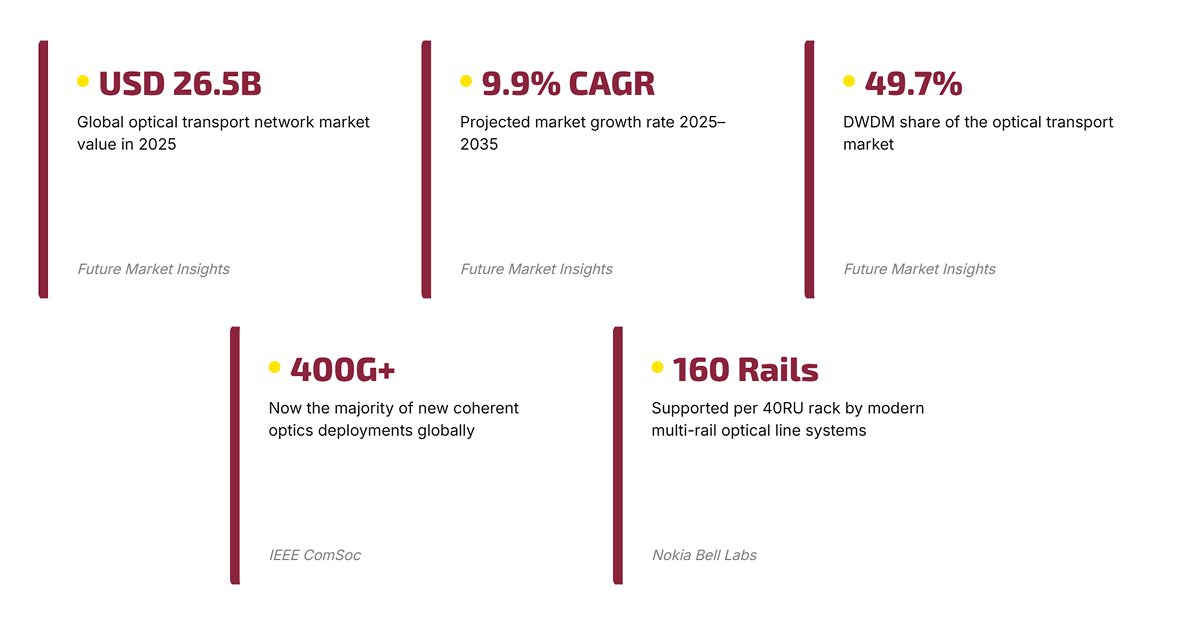
- USD 26.5B — Global optical transport network market value in 2025 — Future Market Insights
- 9.9% CAGR — Projected market growth rate 2025-2035 — Future Market Insights
- 49.7% — DWDM share of the optical transport market — Future Market Insigights
- 400G+ — Now the majority of new coherent optics deployments globally — IEEE ComSoc
- 160 Rails — Supported per 40RU rack by modern multi-rail optical line systems — Nokia Bell Labs
Benefits of Advanced Optical Engineering
Organizations implementing structured optical layer engineering gain:
- Improved signal quality across long distances
- Higher capacity utilization
- Reduced error rates
- Increased network reliability
- Support for higher-speed wavelengths
- Extended fiber infrastructure lifespan
These benefits directly improve network performance.
Preparing for Future Transport Requirements
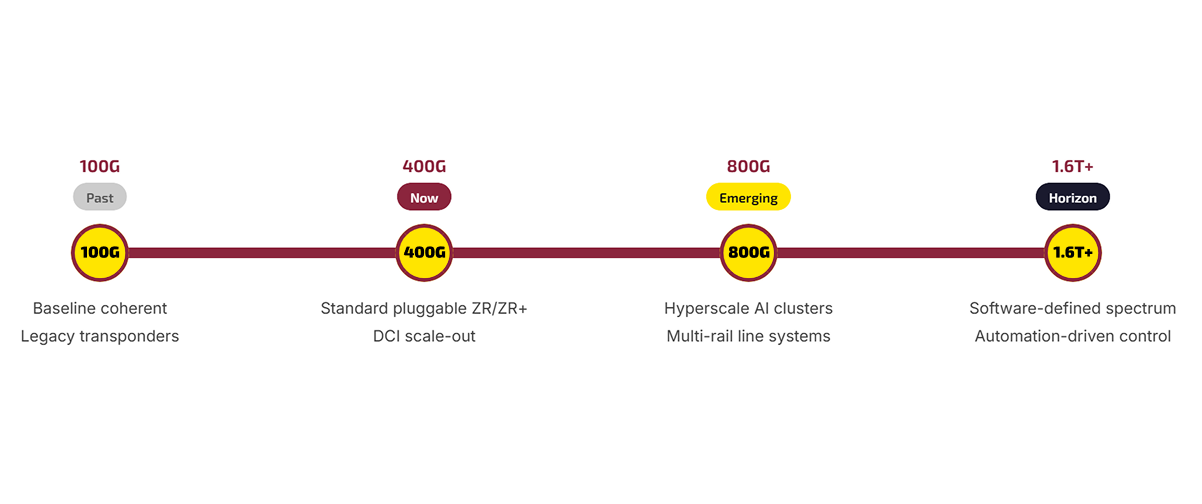
As networks evolve, optical layer engineering must support emerging technologies. AI clusters and edge computing require high-throughput, low-latency connectivity. Future transport design will incorporate:
- Higher-order modulation formats
- Automation-driven power optimization
- Real-time performance monitoring
- Flexible spectrum allocation
- Software-defined optical control
These innovations will further enhance optical transport efficiency. As confirmed by Nokia Bell Labs, AI training clusters increasingly span multiple data centers thousands of kilometers apart, requiring optical infrastructure to support dozens to hundreds of fiber rails simultaneously.
Strategic Takeaways
Optical layer and transport engineering ensure high-speed signals travel efficiently across complex fiber networks. By optimizing link budgets, managing impairments, and designing effective amplification strategies, organizations can deploy scalable, high-capacity transport infrastructure. As bandwidth demand continues to grow in 2026, advanced optical engineering is essential for supporting AI workloads, hyperscale connectivity, and next-generation data center interconnect environments.