
The modern digital ecosystem is expanding at an unprecedented pace. From AI-driven analytics to hyperscale cloud infrastructure and 5G expansion, providers are under immense pressure to deliver higher capacity, lower latency, and improved reliability. Traditional fiber transport methods, while foundational, are no longer sufficient to handle today’s bandwidth-intensive workloads. Organizations now require advanced optical transport solutions that maximize fiber efficiency and support scalable growth.
Dense Wavelength Division Multiplexing (DWDM) has emerged as the backbone technology for high-capacity networks. By enabling multiple wavelengths to transmit over a single fiber pair, DWDM dramatically increases throughput without the need for additional physical infrastructure. In 2026, this capability is more critical than ever, as enterprises, telecom providers, and hyperscale operators race to support AI workloads, cloud interconnectivity, and global data mobility. According to Synergy Research Group, the number of hyperscale data centers globally is expected to reach 1,200 by 2026 — each demanding scalable, high-capacity optical transport.
Engineering excellence in DWDM is no longer just about installing equipment. It involves orchestrating optical performance, ensuring link accuracy, and delivering scalable architecture that supports long-term growth.
The Growing Challenge in Optical Transport
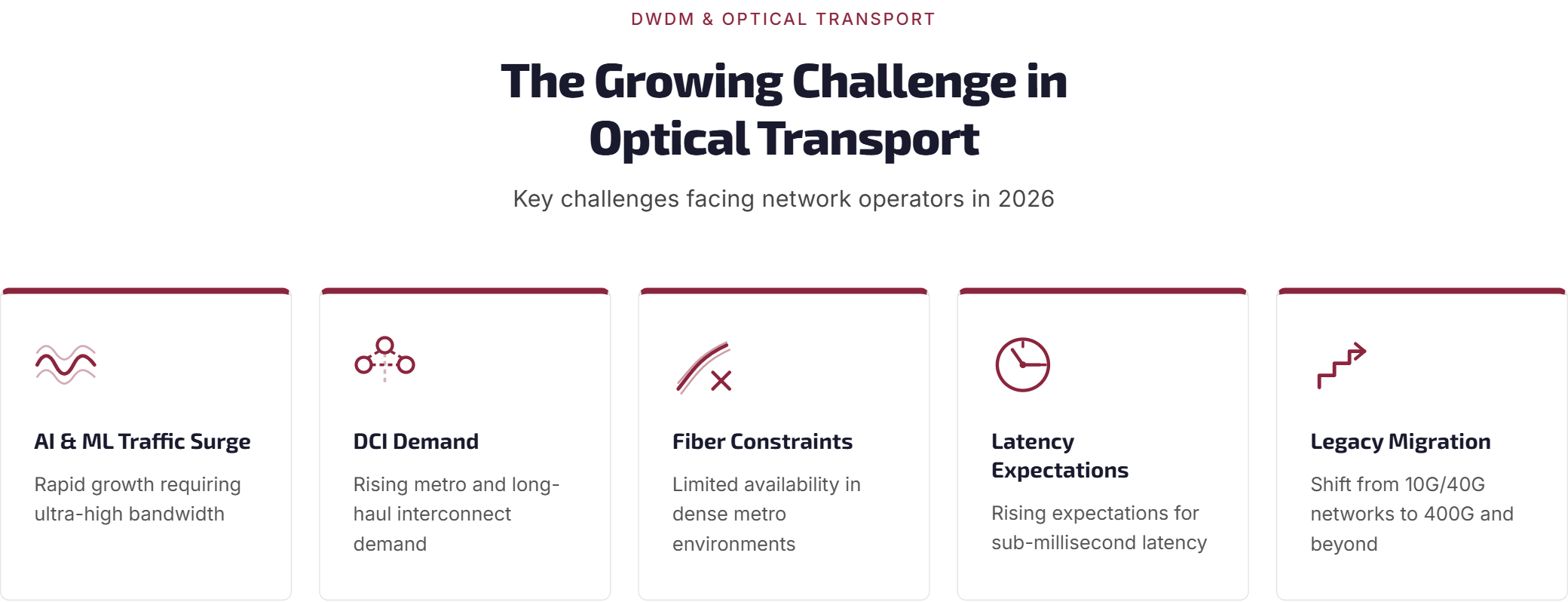
Network operators face several critical challenges in 2026:
- Rapid growth in AI and machine learning traffic requiring ultra-high bandwidth
- Increased demand for data center interconnect between metro and long-haul networks
- Limited fiber availability in dense metro environments
- Rising expectations for sub-millisecond latency
- Migration from legacy 10G and 40G networks to 400G and beyond
Many organizations still rely on legacy transport designs that cannot efficiently utilize available spectrum. This results in stranded capacity, inefficient fiber utilization, and increased operational costs. Without strategic DWDM engineering, network expansion often becomes reactive, leading to emergency upgrades and costly deployments.
According to a 2024 Zayo Bandwidth Report, bandwidth purchased for data center connectivity surged approximately 330% between 2020 and 2024. A Ciena global survey found that 53% of network operators expect AI workloads to place the greatest demand on data center interconnect infrastructure over the next two to three years. TrendForce further reports that the global DCI market is projected to grow 14.3% year-over-year in 2025, surpassing $40 billion.
Advanced DWDM Engineering Approach
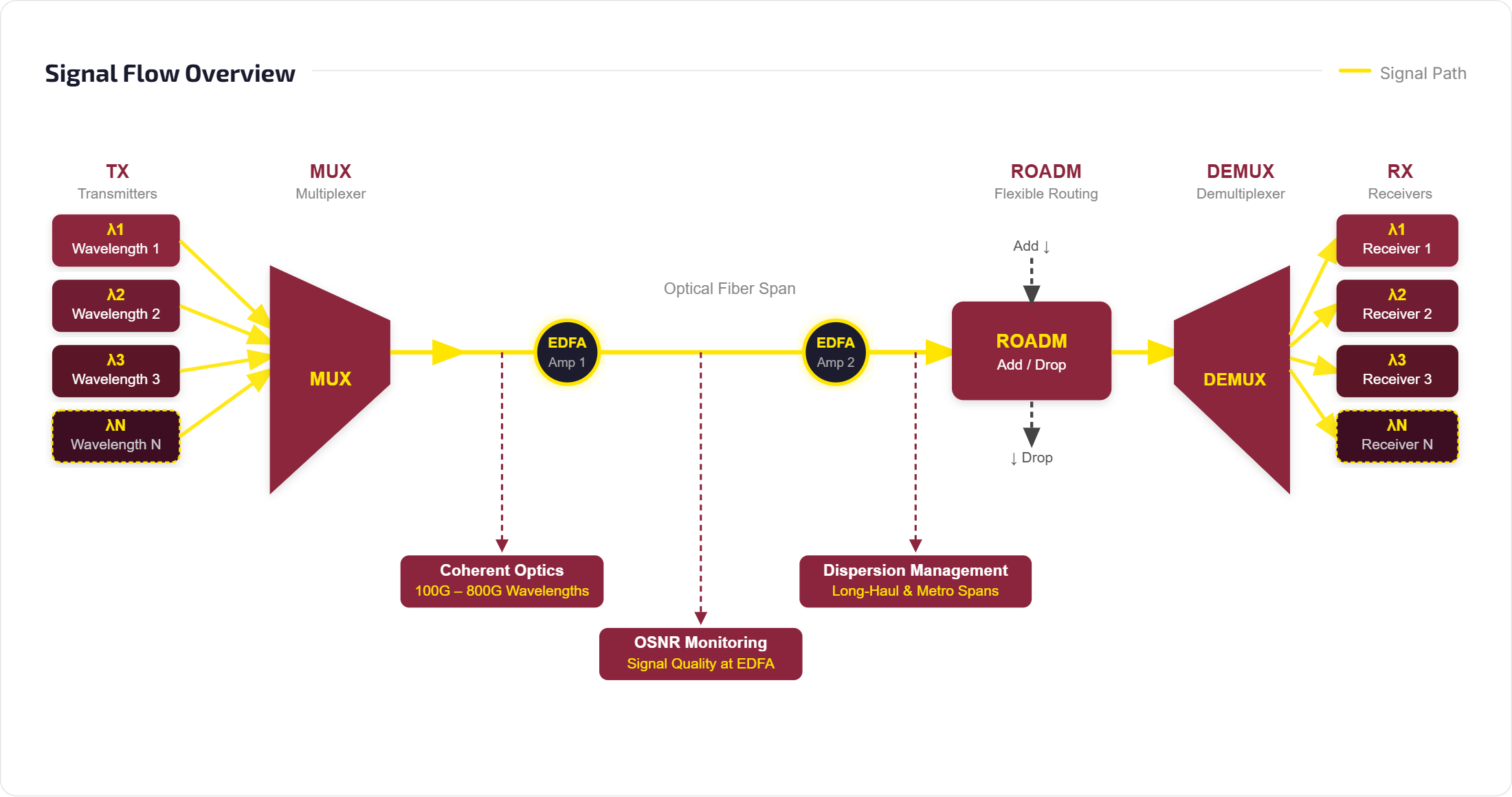
Modern DWDM engineering focuses on maximizing spectral efficiency while maintaining signal integrity. This involves careful planning of wavelength allocation, power budgets, and coherent optics integration.
High-capacity transport engineering includes:
- Spectral efficiency optimization across fiber strands
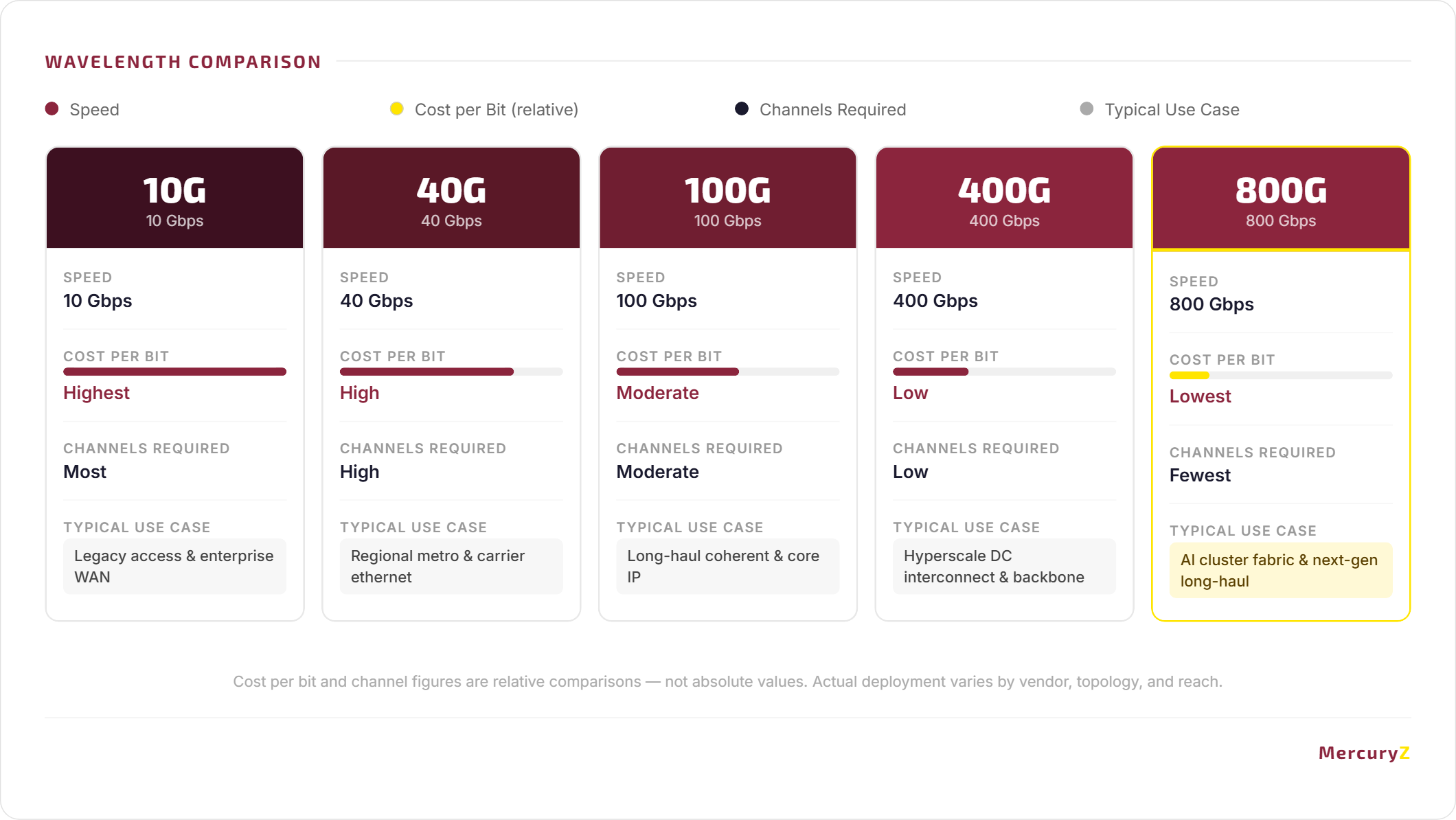
- Coherent optics deployment for 100G to 800G wavelengths
- ROADM-based flexible optical routing
- Vendor-neutral architecture design
- Accurate link-budget calculations for long-haul and metro spans
By combining these elements, engineering teams can transform existing fiber infrastructure into scalable high-capacity transport networks capable of supporting future growth.
Precision Link Budget and Optical Performance
One of the most critical aspects of DWDM engineering is accurate link-budget calculation. This ensures signals maintain optimal power levels across connectors, splices, and fiber spans. Poorly engineered links can lead to signal degradation, reduced reach, and network instability.
Advanced optical engineering includes:
- Power budgeting for long-haul transport
- Amplifier placement optimization
- OSNR planning for coherent optics
- Dispersion management for high-speed signals
- Non-linear effect mitigation
These capabilities ensure networks maintain carrier-grade performance even under heavy traffic loads.
Supporting 400G and Beyond
One of the most critical aspects of DWDM engineering is accurate link-budget calculation. This ensures signals maintain optimal power levels across connectors, splices, and fiber spans. Poorly engineered links can lead to signal degradation, reduced reach, and network instability.
Advanced optical engineering includes:
- Power budgeting for long-haul transport
- Amplifier placement optimization
- OSNR planning for coherent optics
- Dispersion management for high-speed signals
- Non-linear effect mitigation
These capabilities ensure networks maintain carrier-grade performance even under heavy traffic loads.
Use Cases Across Industries
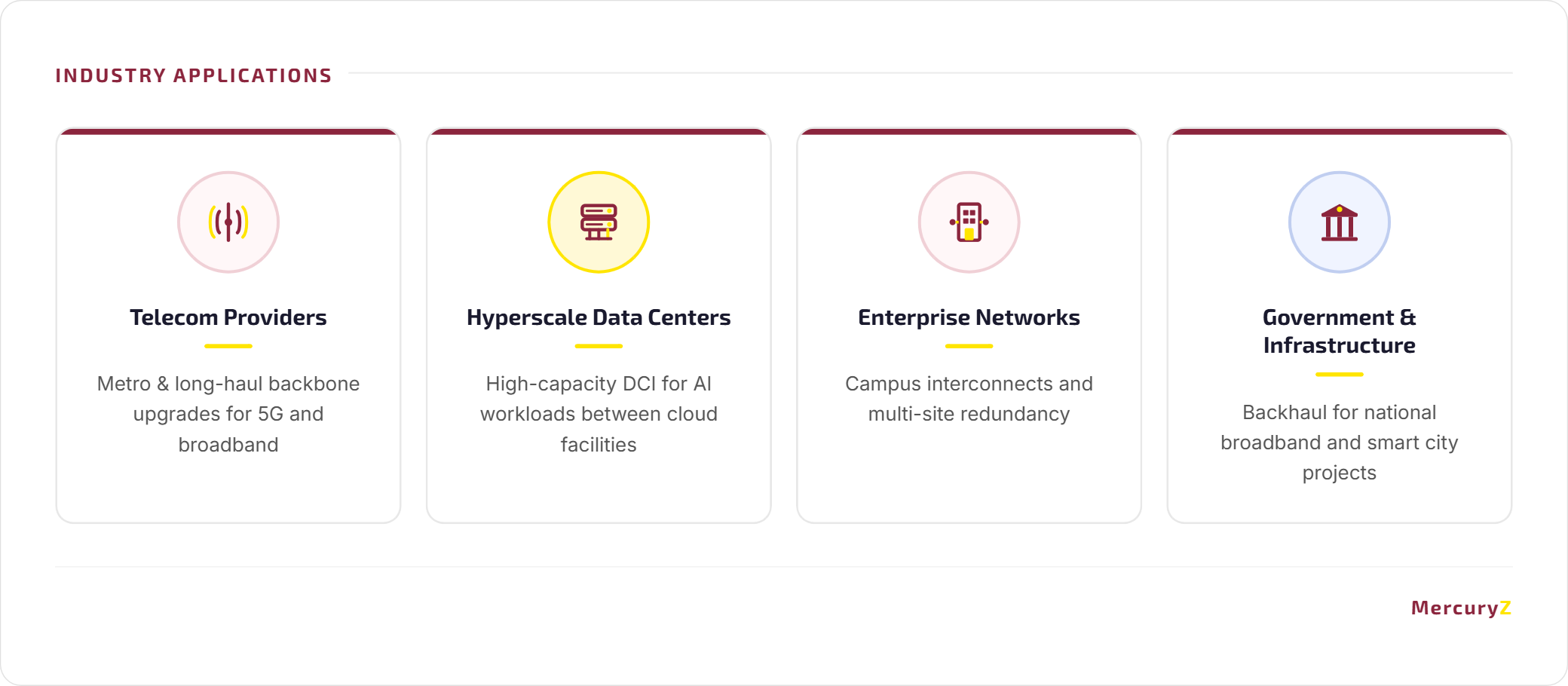
Telecom Providers DWDM supports metro and long-haul backbone upgrades, enabling operators to meet 5G and broadband demand. TeleGeography reports a 23% year-over-year increase in international bandwidth in 2025, bringing total international bandwidth to 1,835 Tbps — a direct measure of how rapidly backbone infrastructure must scale.
Hyperscale Data Centers Cloud providers rely on DWDM for high-capacity data center interconnect between facilities supporting AI workloads. LightCounting forecasts the optical transceiver market for AI clusters will double from $5 billion in 2024 to over $10 billion in 2026.
Enterprise Networks Large enterprises use DWDM for campus interconnects and multi-site redundancy, increasingly requiring 100G+ wavelengths as cloud-first architectures drive internal bandwidth requirements higher.
Government and Infrastructure Projects DWDM enables scalable backhaul for national broadband initiatives and smart city deployments, where long-haul reach and carrier-grade reliability are non-negotiable requirements.
2026 Industry Statistics
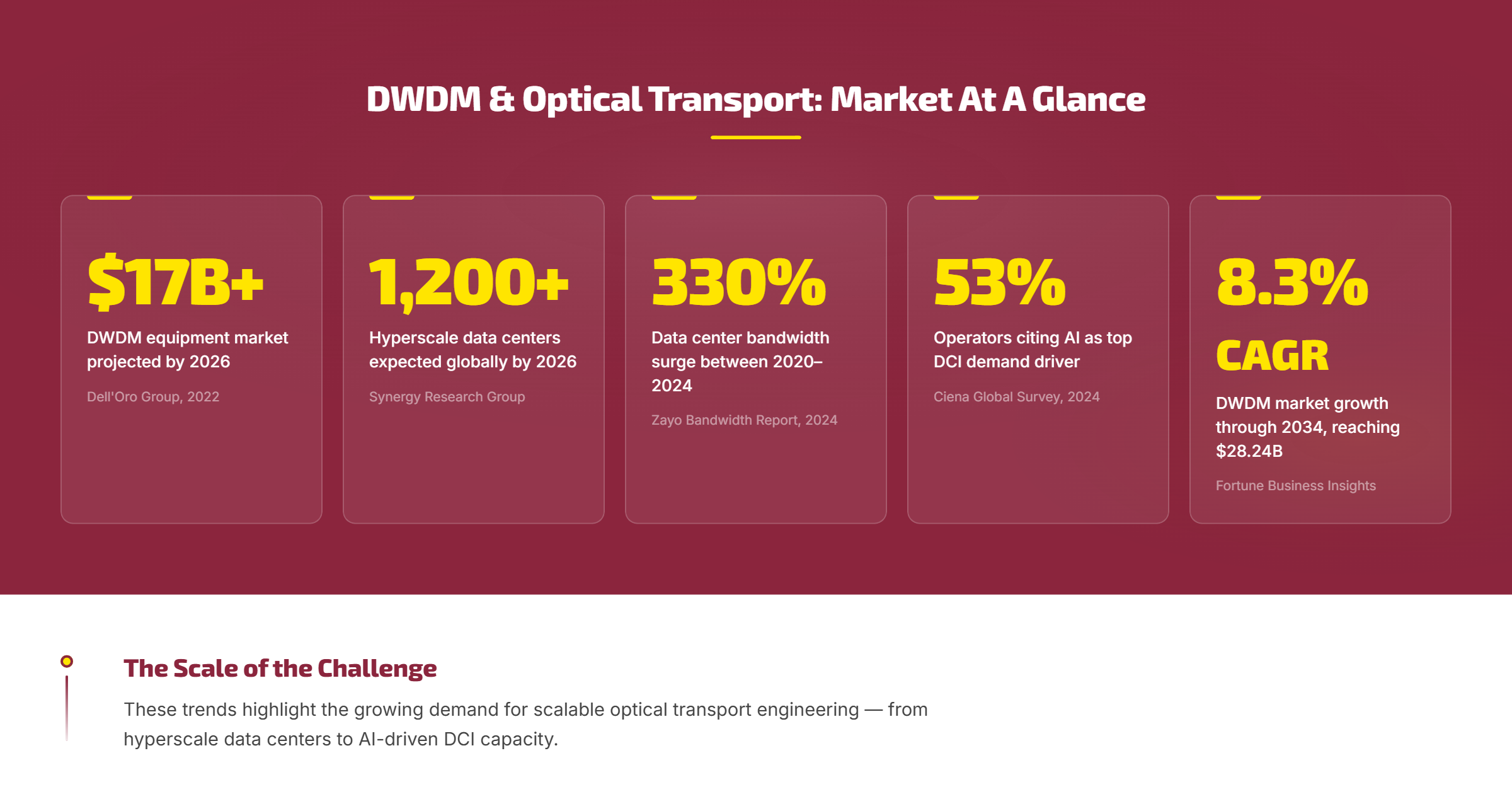
Key statistics illustrating the scale of the challenge:
- DWDM equipment market projected to surpass $17 billion by 2026 — Dell’Oro Group, 2022
- Hyperscale data centers expected to exceed 1,200 globally by 2026 — Synergy Research Group
- Data center bandwidth purchased surged approximately 330% between 2020 and 2024 — Zayo Bandwidth Report, 2024
- 53% of network operators cite AI as the top DCI demand driver — Ciena Global Survey, 2024
- DWDM market growing at 8.3% CAGR, from $14.88B in 2026 to $28.24B by 2034 — Fortune Business Insights
These trends highlight the growing importance of scalable optical transport engineering.
Benefits of Modern DWDM Engineering
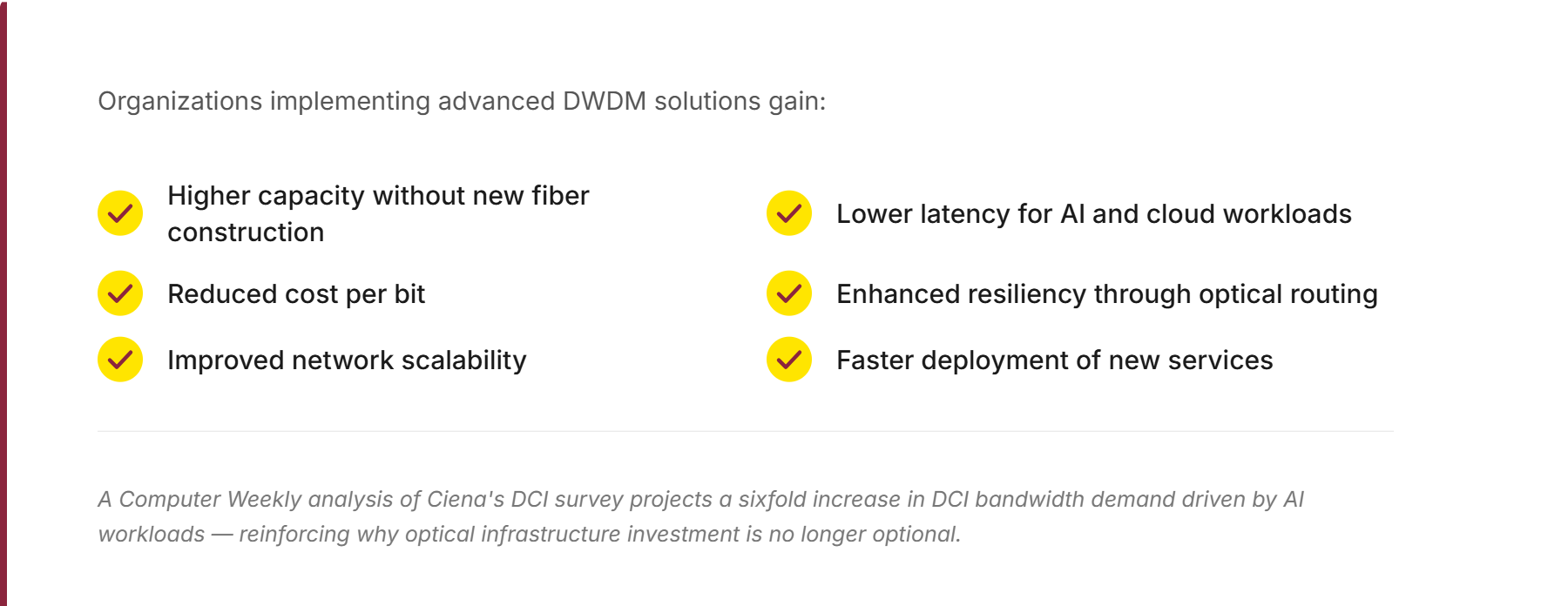
Organizations implementing advanced DWDM solutions gain:
- Higher capacity without new fiber construction
- Reduced cost per bit
- Improved network scalability
- Lower latency for AI and cloud workloads
- Enhanced resiliency through optical routing
- Faster deployment of new services
These advantages make DWDM engineering a critical component of modern network strategy. A Computer Weekly analysis of Ciena’s DCI survey projects a sixfold increase in DCI bandwidth demand driven by AI workloads — reinforcing why optical infrastructure investment is no longer optional.
Future-Ready Optical Transport
As networks evolve, optical transport must support emerging technologies such as AI clusters, edge computing, and real-time analytics. Flexible DWDM architectures allow operators to dynamically allocate wavelengths, scale bandwidth, and adapt to shifting traffic patterns.
Automation, software-defined optical networking, and intelligent monitoring will further enhance performance and operational efficiency. Organizations that invest in strategic DWDM engineering today will be better positioned to support tomorrow’s digital demands. The Cisco Annual Internet Report provides additional context on global traffic growth trends driving these infrastructure requirements.
Key Takeaways
High-capacity networks require more than basic fiber connectivity. They demand precision-engineered optical transport solutions. DWDM technology enables organizations to maximize spectral efficiency, scale bandwidth, and support AI-driven workloads without costly infrastructure expansion.
By leveraging advanced DWDM engineering, businesses can future-proof their networks, reduce operational complexity, and accelerate digital transformation.
Ready to scale your optical network for 2026 and beyond? Connect with engineering experts to design a high-capacity DWDM architecture tailored to your infrastructure needs.