
As optical transport networks evolve to support AI workloads, hyperscale data centers, and high-capacity cloud infrastructure, equipment architecture and node design have become critical components of network performance. Modern optical nodes must deliver flexibility, scalability, and resiliency while supporting rapid bandwidth expansion. In 2026, operators are moving away from rigid point-to-point systems and adopting programmable, software-driven optical architectures that can dynamically adapt to changing traffic demands.
Equipment architecture influences everything from wavelength routing and network recovery to automation and operational efficiency. Poorly designed nodes can create bottlenecks, limit scalability, and increase downtime. By implementing flexible optical node design, organizations can simplify network expansion, improve service agility, and optimize hardware utilization.
Evolution of Optical Node Architecture
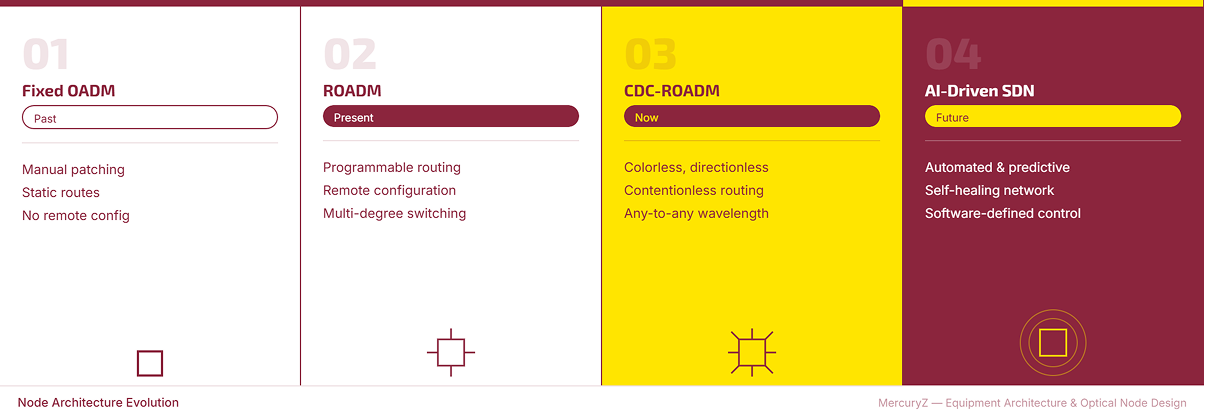
Traditional optical networks relied on fixed add-drop multiplexers and manual provisioning. These systems required physical intervention to activate new services, resulting in slower deployment times. Modern node architecture uses programmable optical platforms that allow remote configuration and automated provisioning.
Key characteristics of modern optical nodes include:
- Software-controlled wavelength routing
- Modular hardware design for scalability
- High-density transponder support
- Integrated amplification and monitoring
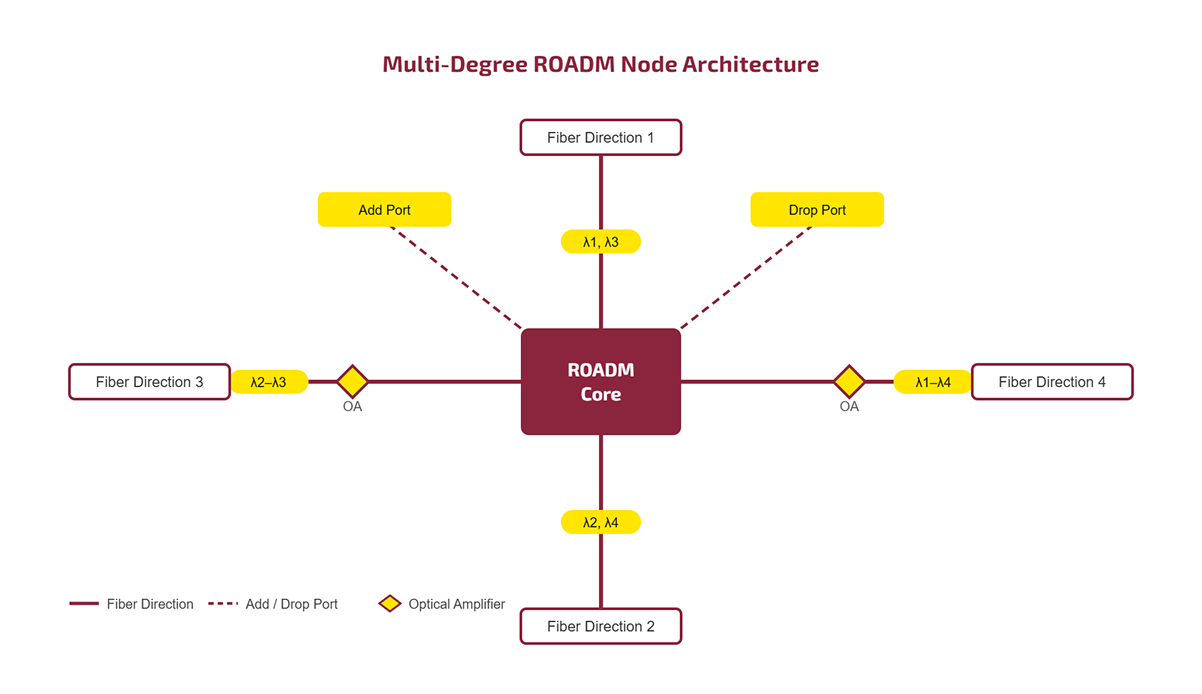
- Multi-degree ROADM capability
These features allow operators to adapt quickly to changing bandwidth requirements.
Vendor-Neutral Equipment Strategy
Many network operators deploy multi-vendor optical environments to avoid vendor lock-in and improve flexibility. Vendor-neutral architecture ensures interoperability across platforms and allows organizations to select best-of-breed solutions.
Benefits of a vendor-neutral strategy include:
- Increased procurement flexibility
- Reduced dependency on a single supplier
- Improved cost competitiveness
- Simplified technology upgrades
- Enhanced interoperability
Engineering teams must validate compatibility across transponders, ROADMs, and management systems to ensure seamless operation.
ROADM-Based Optical Node Design
Reconfigurable Optical Add-Drop Multiplexer technology enables dynamic wavelength routing without manual patching. ROADM nodes allow operators to remotely configure optical paths, improving agility and reducing operational effort.
ROADM design considerations include:
- Degree count for multiple fiber directions
- Optical power balancing
- Channel equalization
- Redundancy planning
- Expansion capability
ROADM-based architecture supports automated provisioning and rapid service activation. According to Future Market Insights, the optical transport network market is projected to grow from USD 26.5 billion in 2025 to USD 68.2 billion by 2035, driven by demand for flexible, programmable optical infrastructure.
Colorless, Directionless, Contentionless Architecture
Advanced optical nodes increasingly adopt colorless, directionless, contentionless design. This architecture removes wavelength restrictions and allows any wavelength to be routed to any direction. CDC architecture improves flexibility and simplifies network expansion.
Advantages of CDC architecture include:
- Simplified wavelength assignment
- Reduced manual configuration
- Improved traffic routing flexibility
- Faster service deployment
- Efficient spectrum utilization
This design is particularly valuable in dynamic metro and data center interconnect environments.
Protection Schemes and Resiliency
Network resiliency is a key requirement for mission-critical applications. Optical node design must incorporate protection mechanisms that ensure service continuity during failures. Common protection strategies include:
- 1+1 protection switching
- 1:N shared protection
- Ring-based protection architectures
- Mesh restoration strategies
- Automatic failover routing
These protection schemes enable rapid traffic restoration in case of fiber cuts or equipment failure.
Circuit Grooming and Capacity Optimization
Efficient node design includes circuit grooming, which aggregates lower-speed traffic into higher-capacity wavelengths. This improves hardware utilization and reduces operational complexity.
Circuit grooming benefits include:
- Reduced number of optical interfaces
- Improved bandwidth utilization
- Lower power consumption
- Simplified network management
- Increased scalability
Proper grooming strategies optimize transport efficiency.
Multi-Layer Integration
Modern optical nodes increasingly integrate multiple network layers. Combining optical transport with IP routing simplifies architecture and reduces equipment footprint. Multi-layer integration supports:
- IP-over-optical deployments
- Reduced hardware requirements
- Lower latency connections
- Simplified network management
- Improved scalability
This approach is particularly beneficial for data center interconnect environments.
Automation and Software-Defined Control
Automation plays a significant role in modern optical node design. Software-defined control platforms enable dynamic provisioning, real-time monitoring, and automated fault recovery.
Automation capabilities include:
- Remote wavelength provisioning
- Automatic power optimization
- Fault detection and isolation
- Performance analytics
- Predictive maintenance
These features reduce operational overhead and improve reliability.
Stats (use exactly as written):
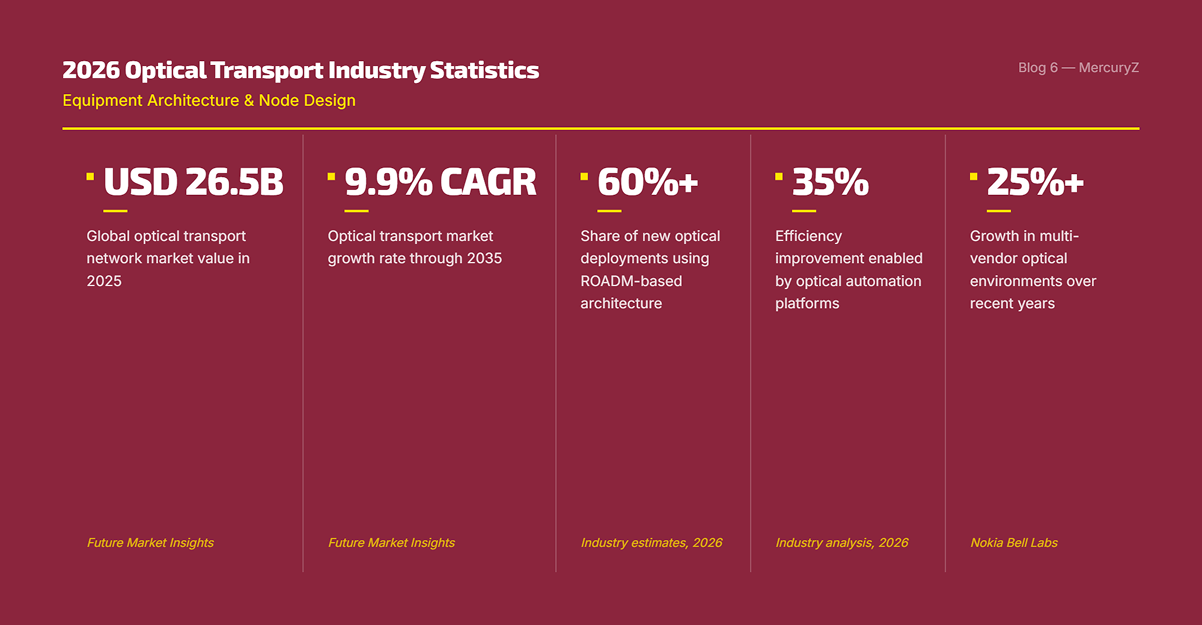
- USD 26.5B — Global optical transport network market value in 2025 — Future Market Insights
- 9.9% CAGR — Optical transport market growth rate through 2035 — Future Market Insights
- 60%+ — Share of new optical deployments using ROADM-based architecture — Industry estimates, 2026
- 35% — Efficiency improvement enabled by optical automation platforms — Industry analysis, 2026
- 25%+ — Growth in multi-vendor optical environments over recent years — Nokia Bell Labs
Scalability for Future Growth
Optical node architecture must support future bandwidth expansion. Scalability considerations include:
- Modular chassis design
- Support for higher-speed optics
- Expandable ROADM degrees
- Flexible spectrum allocation
- Software upgrade capability
Scalable nodes reduce the need for complete hardware replacement.
Supporting Hyperscale and AI Infrastructure
Hyperscale data centers and AI clusters require high-capacity, low-latency connectivity. Optical node design must support:
- High-density transponder deployment
- Low-latency switching paths
- Redundant connectivity
- Rapid provisioning capability
- Scalable wavelength routing
As confirmed by Nokia Bell Labs, AI and cloud providers now deploy dozens to hundreds of fiber rails between data centers, demanding high-density optical node infrastructure that can scale without proportional increases in space or power.
Operational Benefits of Modern Node Design
Organizations deploying advanced optical node architecture gain several advantages:
- Faster service activation
- Improved network resiliency
- Higher hardware utilization
- Reduced operational costs
- Enhanced scalability
- Simplified management
These benefits improve both technical performance and business outcomes.
Strategic Takeaways
Equipment architecture and optical node design are fundamental to building scalable transport networks. By implementing flexible ROADM-based platforms, CDC architecture, and automated control, organizations can improve agility and reliability. As bandwidth demand continues to grow in 2026, well-designed optical nodes provide the foundation for supporting AI workloads, hyperscale connectivity, and next-generation data center interconnect environments.