
The rapid expansion of AI-driven applications, cloud computing, and high-performance data center interconnects is transforming how network operators approach capacity planning. Traffic growth is no longer linear. Instead, organizations are experiencing exponential increases in bandwidth demand driven by hyperscale data centers, 5G rollout, edge computing, and real-time analytics. In this environment, reactive network upgrades are costly and inefficient. Strategic capacity planning and optical network architecture are essential for ensuring scalability, optimizing existing infrastructure, and supporting long-term growth.
In 2026, network operators must balance two priorities. They must maximize utilization of existing fiber assets while preparing for significant increases in bandwidth requirements. This requires a data-driven approach that combines utilization analysis, growth forecasting, and flexible optical design. By implementing structured capacity planning, organizations can avoid congestion, reduce emergency upgrades, and improve overall network performance.
Understanding Modern Traffic Growth
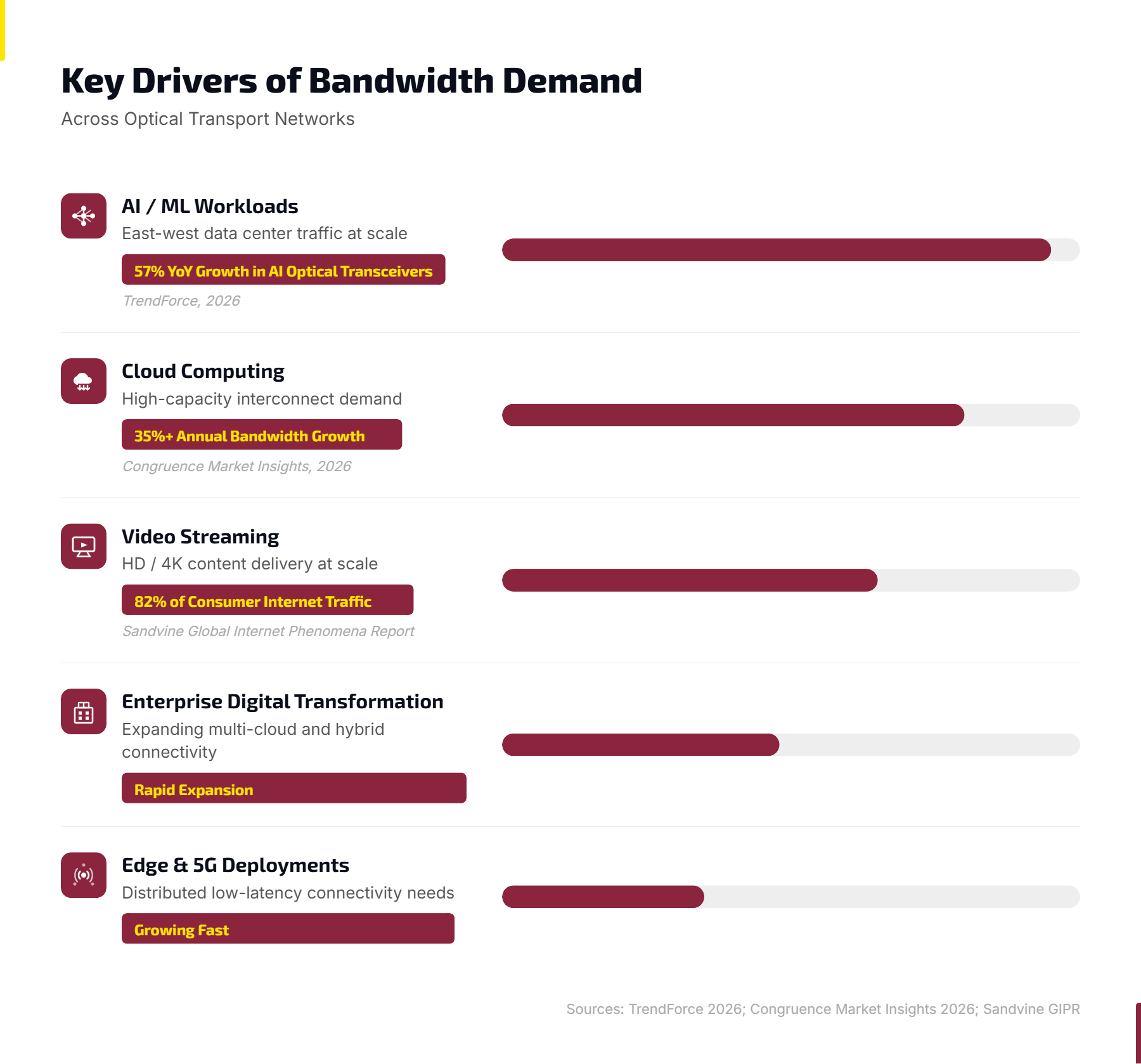
Several key trends are driving bandwidth demand across optical transport networks. AI and machine learning workloads generate massive east-west traffic between data centers. Cloud computing continues to expand, increasing the need for high-capacity data center interconnect. Video streaming, enterprise digital transformation, and edge deployments further contribute to traffic growth.
These trends create pressure on both metro and long-haul networks. Operators must support high-throughput applications while maintaining low latency. Without proper planning, heavily utilized routes can become congested, affecting service quality and customer experience.
According to TrendForce (2026), the global AI-focused optical transceiver market is projected to grow from $16.5 billion in 2025 to $26 billion in 2026, representing over 57% year-over-year growth — a direct reflection of the bandwidth pressure AI workloads are placing on optical infrastructure. The Cisco Annual Internet Report further projects that cloud traffic will account for approximately 75% of all data center traffic as hyperscale adoption continues.
Utilization Audits as the Foundation
Capacity planning begins with a comprehensive utilization audit. This process evaluates current network performance and identifies potential bottlenecks. Engineers analyze:
- Wavelength utilization across fiber spans
- Peak traffic patterns and seasonal variations
- High-growth geographic regions
- Latency-sensitive routes
- Spare capacity availability
Utilization audits provide a clear picture of network health. This data enables operators to prioritize upgrades and allocate resources efficiently.
Traffic Forecasting and Growth Modeling
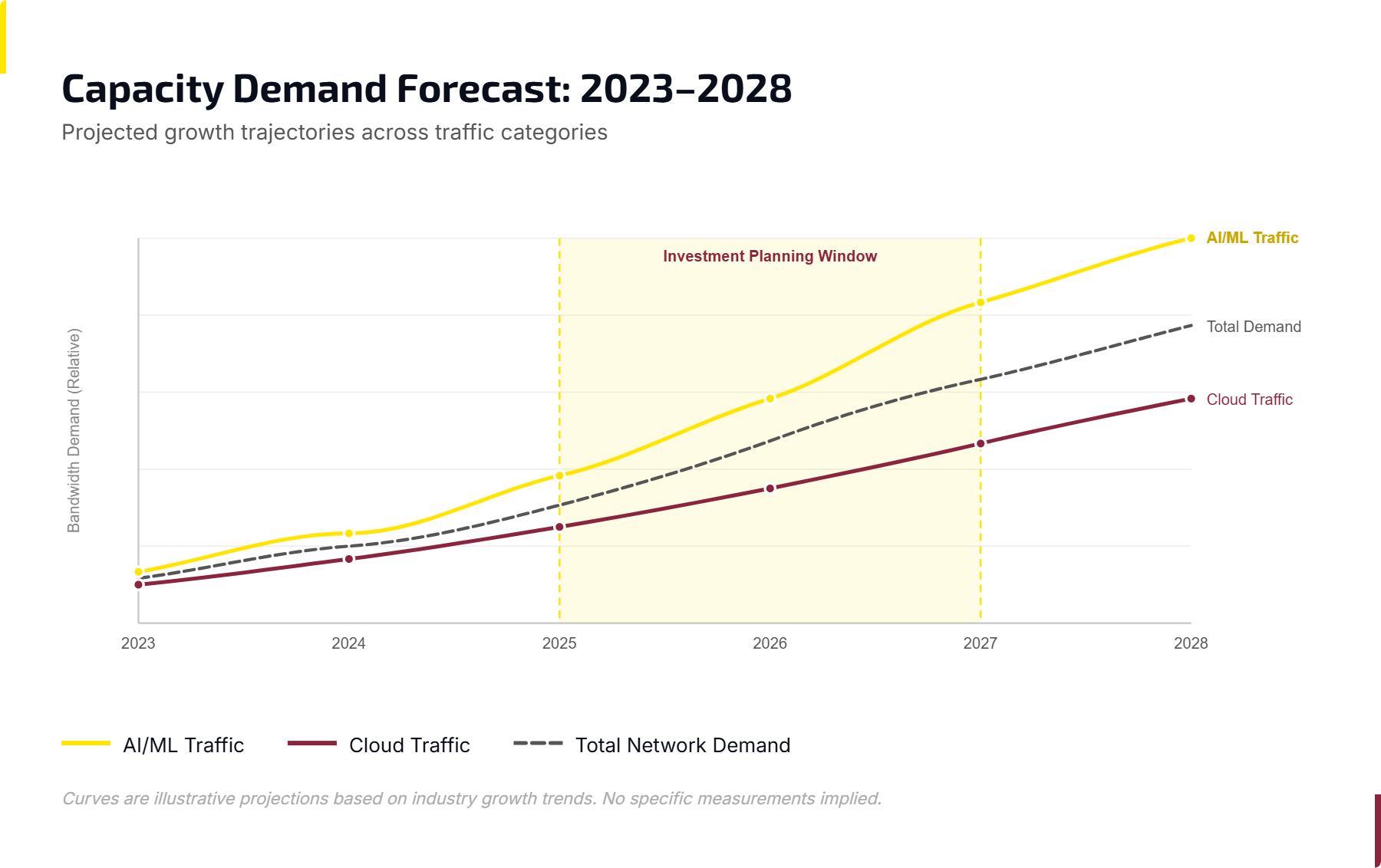
Forecasting future demand is essential for proactive planning. By analyzing historical data and market trends, engineering teams can predict capacity requirements. Growth modeling typically includes:
- Historical traffic trend analysis
- AI workload projections
- Data center expansion plans
- Regional broadband growth forecasts
- Enterprise demand patterns
Accurate forecasting reduces the risk of unexpected congestion and supports phased infrastructure investment. Data center bandwidth demand has grown at approximately 30% year-over-year, driven primarily by cloud and AI workloads — making structured forecasting a non-negotiable part of network strategy.
Network Scaling Strategies
Once growth projections are established, operators can implement scaling strategies. These approaches extend network capacity without requiring immediate fiber construction. Common scaling methods include:
- Adding new wavelengths to existing fiber
- Upgrading transponders to higher speeds
- Expanding optical spectrum utilization
- Deploying flexible grid technology
- Optimizing amplifier configurations
These strategies allow networks to grow incrementally while maintaining performance.
Migration from Legacy to High-Capacity Transport
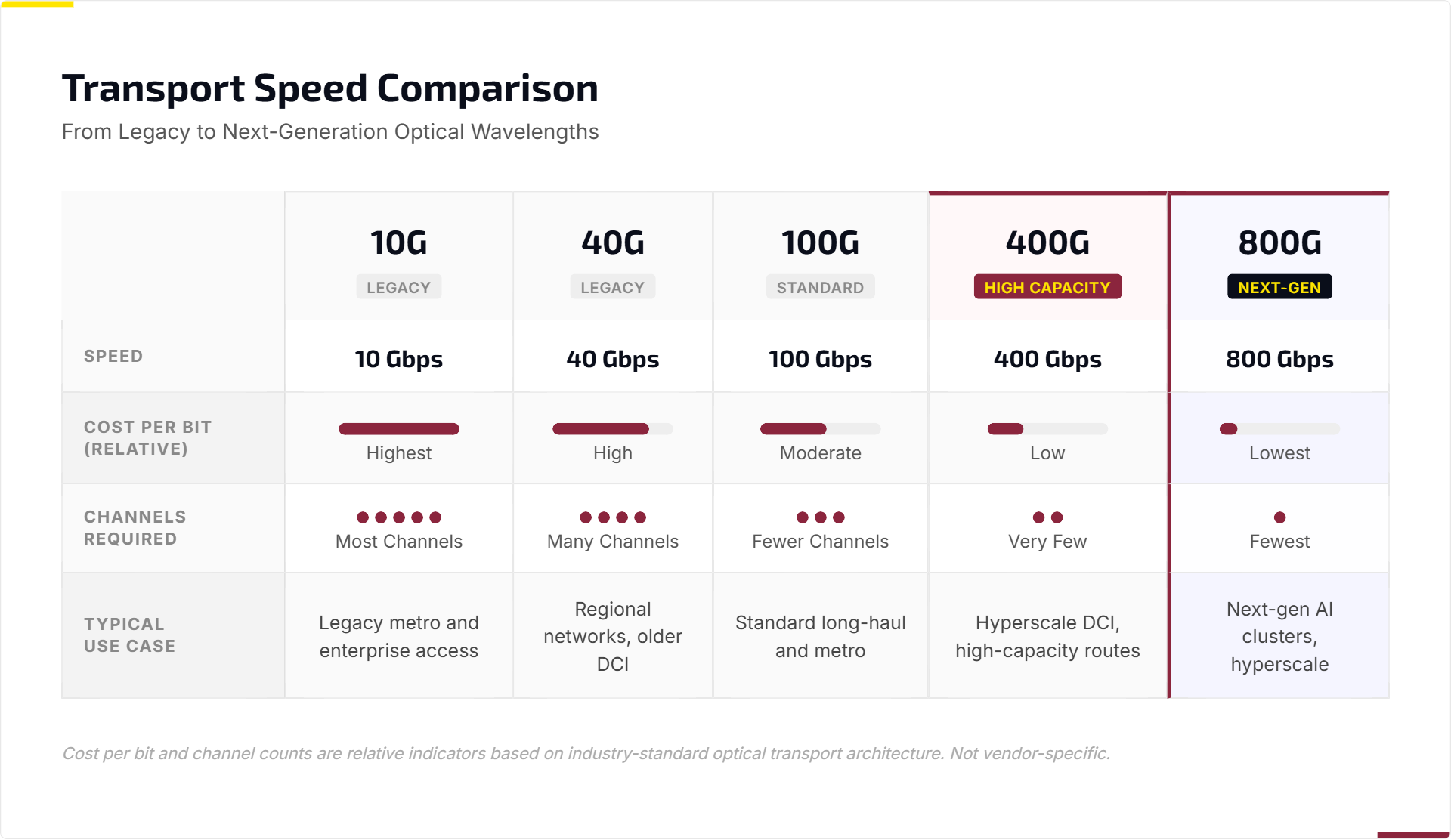
Many networks still operate legacy 10G and 40G wavelengths. Migrating to 100G, 400G, and 800G transport significantly improves efficiency. Higher-capacity wavelengths reduce cost per bit and simplify architecture by decreasing the number of required channels.
Migration planning includes:
- Evaluating fiber quality for high-speed transport
- Assessing amplifier compatibility
- Updating optical modules and transponders
- Planning phased service migration
- Ensuring backward compatibility
Careful migration planning ensures minimal disruption during upgrades. According to LightCounting and industry datacom reports, the high-speed datacom optical market is expected to expand from approximately $9 billion in 2024 to nearly $12 billion in 2026, with 800GbE driving the next wave of hyperscale deployments.
Spectrum Expansion and Flexible Grid
Modern optical systems support flexible grid technology, allowing operators to allocate spectrum dynamically. This improves spectral efficiency and supports higher-capacity wavelengths. Spectrum expansion strategies include:
- Opening additional C-band spectrum
- Integrating L-band capacity
- Deploying flexible channel spacing
- Optimizing guard bands
- Supporting mixed-rate wavelength environments
These techniques maximize fiber utilization and delay the need for new construction.
IP and Optical Layer Integration
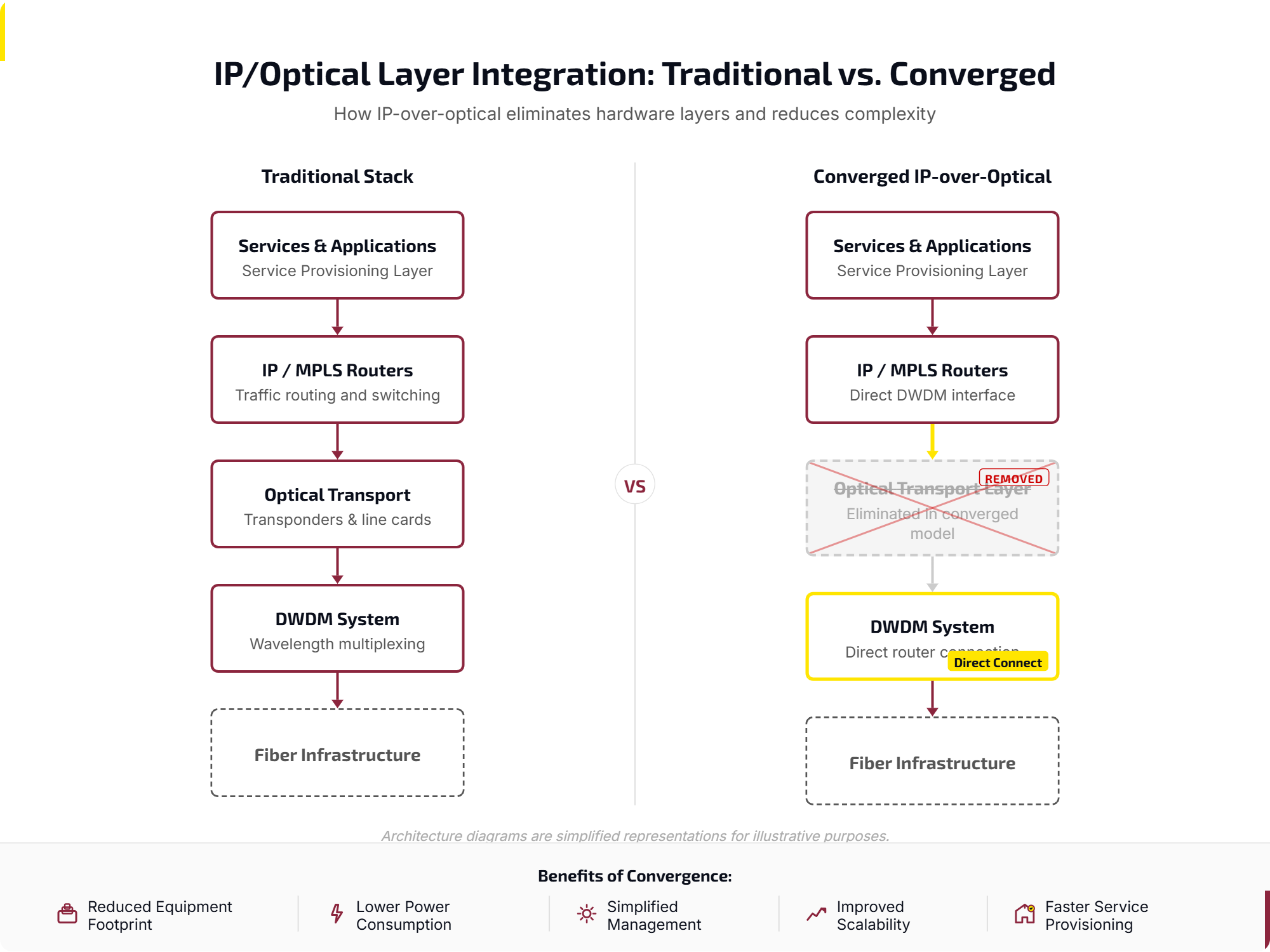
Capacity planning increasingly involves integrating IP and optical layers. Converged architectures improve efficiency and reduce hardware requirements. IP-over-optical solutions allow routers to connect directly to DWDM systems, simplifying design and reducing latency.
Benefits of layer integration include:
- Reduced equipment footprint
- Lower power consumption
- Simplified management
- Improved scalability
- Faster service provisioning
This approach supports modern data center and AI workloads. A 2026 analysis from OFC indicates that all high-bandwidth data center interconnects are expected to become optical within five years, driven by inference workload growth and the push toward co-packaged optics (CPO).
2026 Industry Statistics
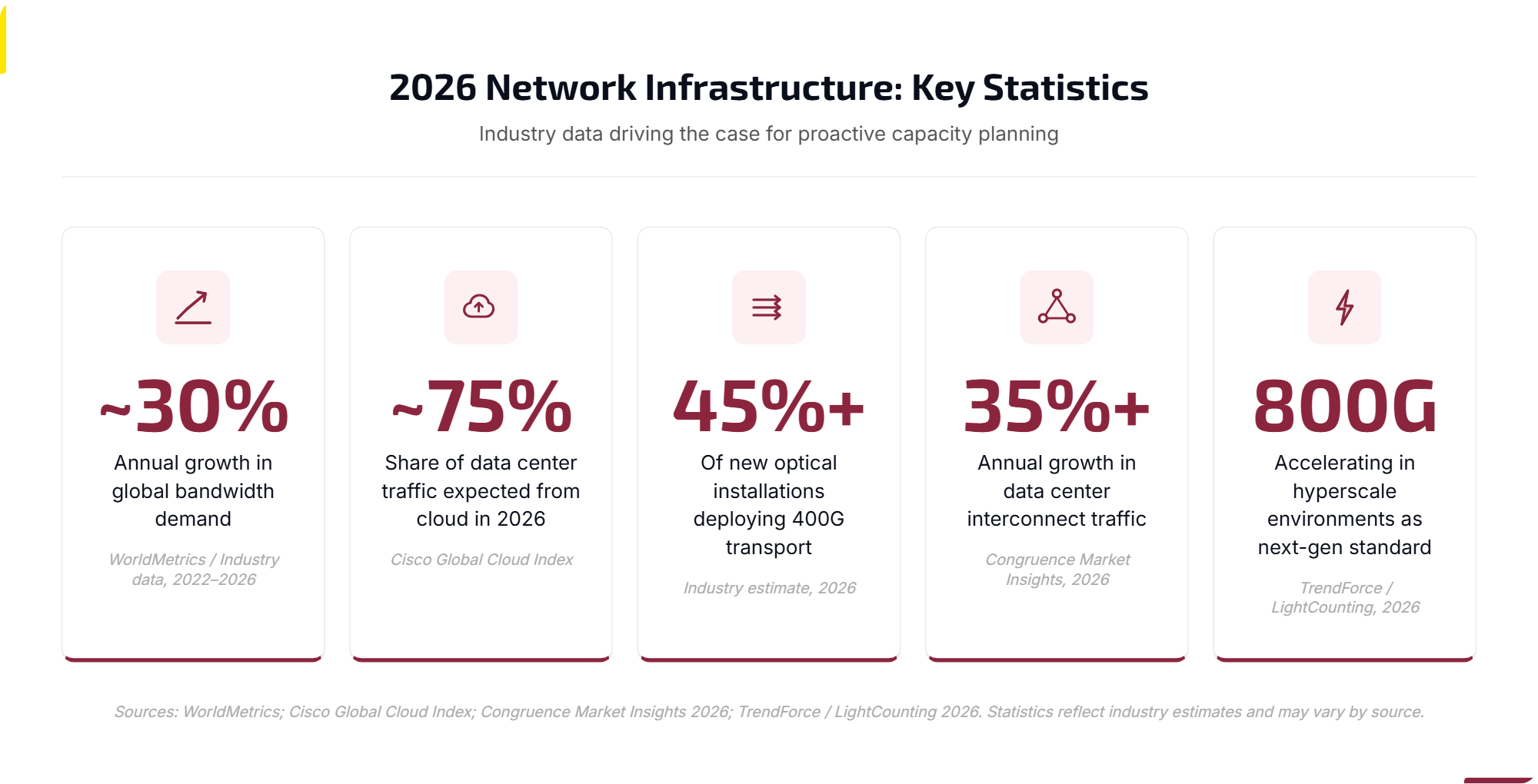
Key statistics illustrating the scale of the challenge:
- Global network bandwidth demand is growing at approximately 30 percent annually
- Cloud traffic is expected to account for nearly 75 percent of total data center traffic in 2026
- 400G optical transport deployments represent more than 45 percent of new installations — Industry estimate, 2026
- Data center interconnect traffic is increasing at over 35 percent per year — Congruence Market Insights, 2026
- 800G transport adoption is accelerating, particularly in hyperscale environments — TrendForce, 2026
These trends emphasize the need for proactive capacity planning.
Benefits of Strategic Capacity Planning
Organizations that implement structured capacity planning gain significant operational advantages. These include:
- Reduced risk of network congestion
- Improved utilization of existing infrastructure
- Lower capital expenditure through phased upgrades
- Faster deployment of new services
- Enhanced network reliability
- Better alignment with business growth
Strategic planning ensures networks remain scalable and cost-effective.
Supporting Long-Term Network Evolution
Capacity planning is not a one-time activity. Networks must evolve continuously as demand increases. Long-term strategies include:
- Regular utilization monitoring
- Periodic growth forecasting updates
- Incremental hardware upgrades
- Spectrum optimization initiatives
- Integration of automation tools
These practices ensure networks remain adaptable to changing requirements.
Preparing for AI and Edge Growth
AI clusters and edge computing are reshaping traffic patterns. Instead of centralized flows, networks must support distributed architectures. Capacity planning must account for:
- East-west traffic between data centers
- Low-latency edge connectivity
- High-bandwidth AI training clusters
- Rapid scaling requirements
Designing with these factors in mind ensures future readiness. A Ciena and Heavy Reading study signals that AI will become a primary source of metro and long-haul traffic within three years, while most optical networks remain only partially prepared, reinforcing the urgency of proactive capacity investment.
Strategic Takeaways
Capacity planning and optical network architecture are critical for supporting modern bandwidth demands. By combining utilization audits, growth forecasting, and scalable optical design, organizations can maximize infrastructure efficiency and prepare for future expansion. Proactive planning reduces operational risk, improves performance, and ensures networks can support AI, cloud, and high-capacity data center interconnect environments.