
Optical network design plays a critical role in ensuring high-performance, scalable, and resilient transport infrastructure. As bandwidth demand continues to grow in 2026, operators must move beyond basic connectivity and adopt structured planning methodologies that optimize fiber routes, wavelength allocation, and spectral efficiency. Whether supporting hyperscale data centers, AI workloads, or long-haul backbone networks, effective optical design directly impacts latency, reliability, and cost efficiency.
Modern networks must support dynamic traffic patterns, multi-terabit capacity, and low-latency applications. Poorly designed routes, inefficient spectrum allocation, and lack of redundancy can create performance bottlenecks and increase operational risk. Strategic optical network design ensures that every fiber path is optimized for maximum reach, minimal signal degradation, and future scalability.
Importance of Strategic Fiber Route Planning
Fiber route planning is the foundation of optical network design. Engineers must evaluate geographic, technical, and operational factors to determine optimal paths. Proper route selection reduces attenuation, improves latency, and enhances network resiliency.
Key route planning considerations include:
- Selecting the shortest feasible path to minimize latency
- Avoiding high-risk zones such as flood-prone or construction-heavy areas
- Ensuring access to power and amplification sites
- Maintaining route diversity for redundancy
- Evaluating fiber quality and age
By carefully planning routes, operators can improve performance while reducing long-term maintenance challenges.
Geographic Optimization for Metro and Long-Haul Networks
Metro and long-haul environments require different design strategies. Metro networks prioritize low latency and high density connectivity, while long-haul networks focus on reach and signal integrity.
Geographic optimization includes:
- Designing ring architectures for metro resiliency
- Balancing traffic across multiple routes
- Planning aggregation points near data centers
- Optimizing span lengths for amplification efficiency
- Ensuring diverse entry points for critical facilities
These strategies improve both performance and operational flexibility.
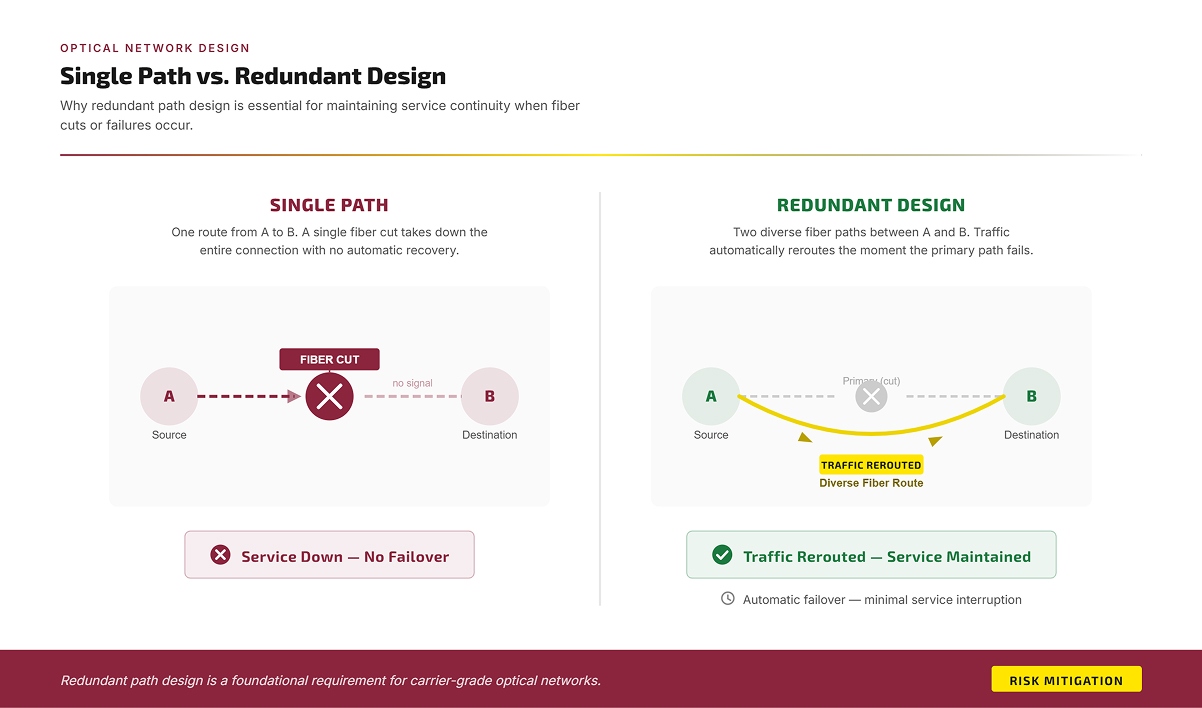
Risk Mitigation Through Redundant Path Design
Network outages can occur due to fiber cuts, power failures, or environmental factors. Optical network design must incorporate redundancy to maintain service continuity. Engineers implement protection strategies such as:
- Diverse routing across separate conduits
- Ring-based metro topologies
- Mesh architectures for backbone networks
- Dual-homing for critical nodes
- Automatic failover paths
These designs ensure that traffic can reroute quickly in case of failure.
Wavelength and Spectrum Allocation Planning
Efficient wavelength allocation is essential for maximizing fiber capacity. Proper spectrum planning ensures minimal interference and optimal signal performance. Engineers evaluate:
- Channel spacing based on grid standards
- Guard band allocation
- Mixed-rate wavelength environments
- Future expansion requirements
- Power balancing across channels
Effective spectrum planning enables operators to support both current and future capacity needs.
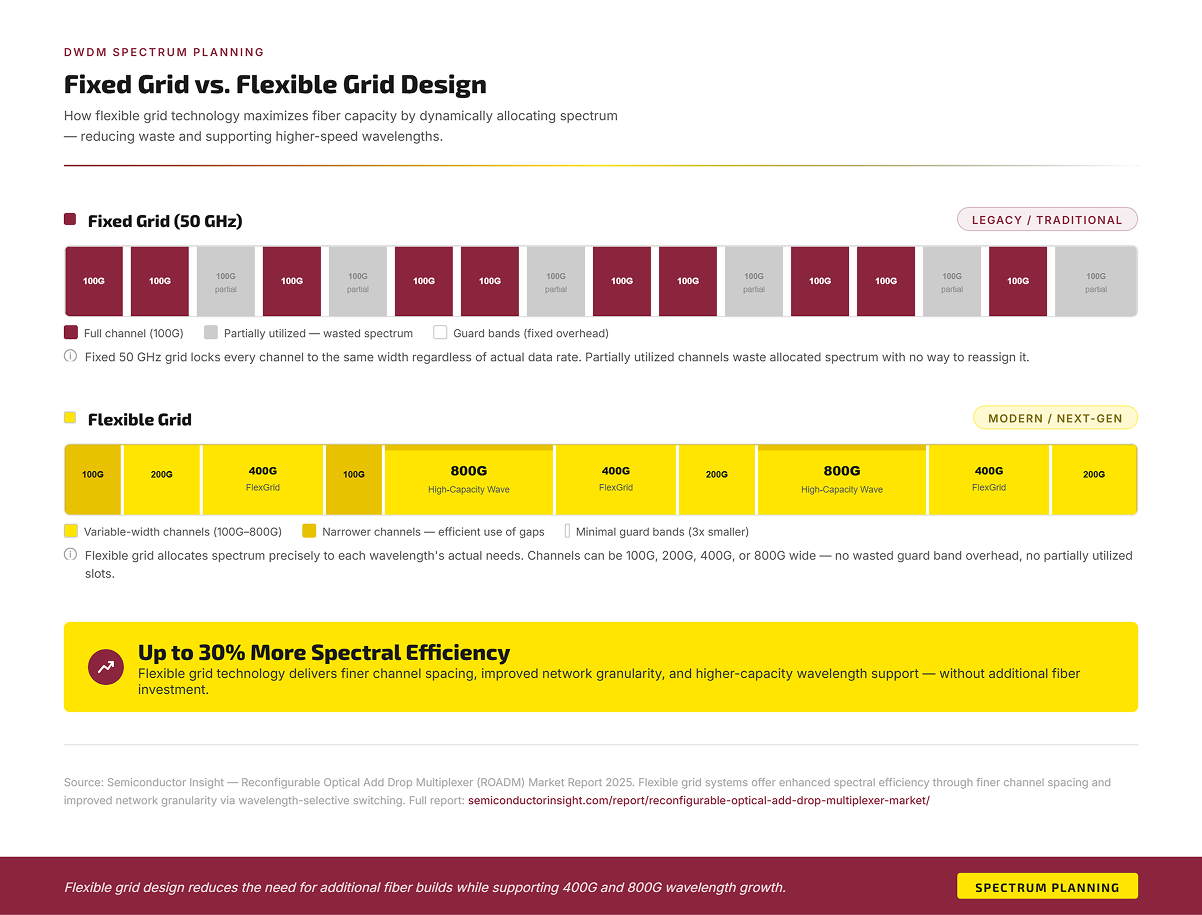
Fixed Grid Versus Flexible Grid Design
Traditional DWDM systems used fixed channel spacing, typically 50 GHz or 100 GHz. Modern networks increasingly adopt flexible grid technology, which allows dynamic spectrum allocation. Flexible grid design supports higher-capacity wavelengths and improves efficiency.
Advantages of flexible grid design include:
- Increased spectral efficiency
- Support for 400G and 800G wavelengths
- Dynamic bandwidth allocation
- Improved fiber utilization
- Reduced need for additional fiber builds
This approach is particularly valuable in high-density data center environments.
Latency Optimization in Optical Design
Latency is a critical factor for AI workloads, financial trading, and real-time applications. Optical network design directly impacts latency through route selection and equipment placement. Engineers optimize latency by:
- Minimizing physical distance
- Reducing unnecessary intermediate nodes
- Optimizing amplifier placement
- Using low-latency coherent optics
- Avoiding excessive regeneration points
These optimizations ensure that applications requiring real-time processing perform efficiently.
Integration with Data Center Interconnect Architecture
Data center interconnect design requires careful optical planning. High-capacity DCI routes must support large traffic volumes with strict performance requirements. Optical design considerations include:
- Dedicated high-capacity fiber paths
- Redundant DCI routes
- Low-latency metro connectivity
- Spectrum allocation for future growth
- Power balancing for long-distance links
Proper DCI planning supports hyperscale and enterprise cloud deployments.
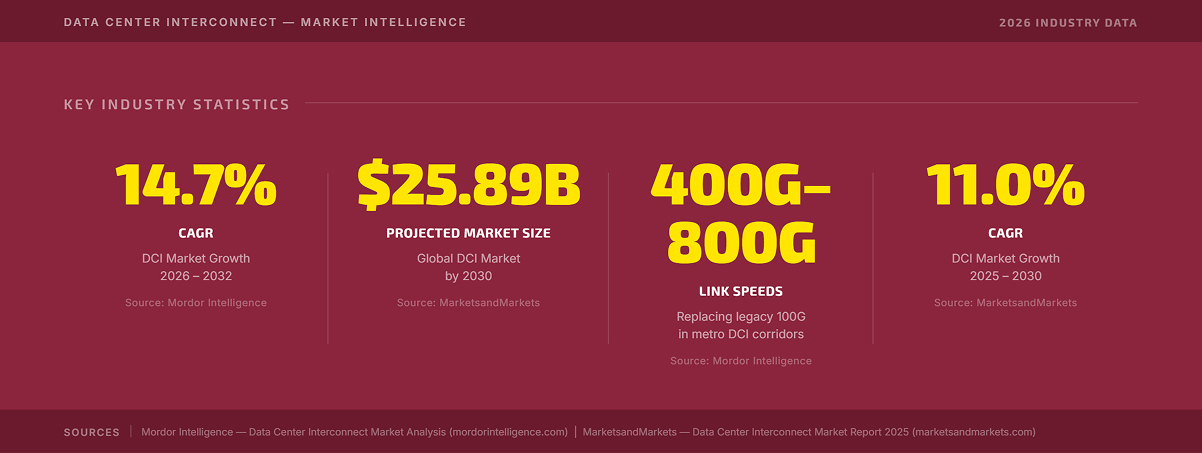
The global Data Center Interconnect (DCI) market reflects how rapidly this segment is growing. According to MarketsandMarkets, the DCI market was valued at USD 15.38 billion in 2025 and is projected to reach USD 25.89 billion by 2030, growing at a CAGR of 11.0%. Mordor Intelligence places that growth even higher, citing a 14.73% CAGR through 2032, driven by AI workload migration and hyperscale expansion. Near-term activity is concentrated in metropolitan corridors, where 400 Gbps and 800 Gbps links are replacing legacy 100 Gbps waves.
2026 Industry Statistics
The data center interconnect market was valued at USD 15.38 billion in 2025 and is projected to reach USD 25.89 billion by 2030, growing at an 11.0% CAGR, according to MarketsandMarkets. Mordor Intelligence projects the market to reach USD 42.45 billion by 2032 at a 14.73% CAGR, fueled by AI workload migration and the expansion of hyperscale data centers. Metropolitan corridors are seeing the fastest near-term growth as 400G and 800G links replace legacy 100G infrastructure. The transition to flexible grid architectures and software-defined control platforms is further accelerating adoption, with software-defined networking projected to grow at a 16.12% CAGR through 2032. The Asia-Pacific region leads in capacity additions, while North America dominates research and development investment.
Spectrum Efficiency and Capacity Maximization
Modern optical networks must maximize spectrum utilization. Engineers implement advanced techniques such as:
- Tight channel spacing with flexible grid
- Advanced modulation formats
- Power equalization across wavelengths
- Mixed-rate channel optimization
- Dynamic spectrum reallocation
These strategies extend the life of existing fiber infrastructure.
Planning for Future Scalability
Optical network design must account for future growth. Scalability planning includes:
- Reserving spectrum for additional wavelengths
- Designing modular node architecture
- Supporting higher-speed optics
- Enabling automated provisioning
- Incorporating software-defined control
Future-ready design reduces upgrade complexity.
Operational Benefits of Structured Design
Organizations that invest in comprehensive optical design gain several advantages:
- Lower latency across key routes
- Improved network resiliency
- Higher capacity utilization
- Reduced operational costs
- Faster service deployment
- Simplified network expansion
These benefits improve both technical performance and business outcomes.
Supporting AI and Cloud Infrastructure
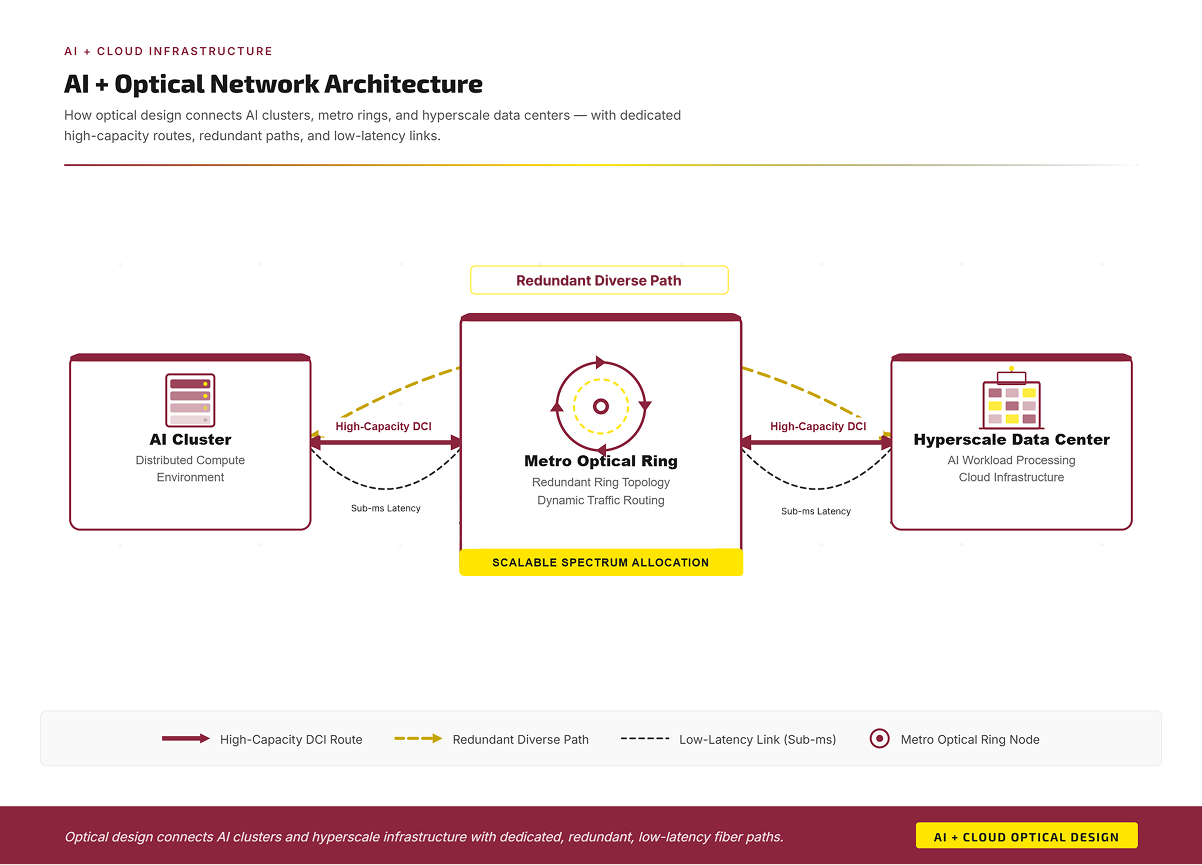
AI and cloud deployments require high-capacity, low-latency connectivity. Optical design must support distributed compute environments. Key considerations include:
- High-capacity metro rings
- Dedicated DCI routes
- Redundant connectivity for AI clusters
- Low-latency inter-site links
- Scalable spectrum allocation
The DCI market’s rapid expansion is directly tied to AI infrastructure demands. As Mordor Intelligence notes, hyperscale operators are moving away from monolithic enterprise links toward AI-optimized, low-latency fabrics built on coherent optics, photonic switching, and software-defined control. Sustainability mandates are also shaping network design, spurring adoption of energy-efficient switching and liquid-cooling-ready short-reach optics.
These requirements highlight the importance of advanced planning.
Strategic Takeaways
Optical network design and planning form the backbone of scalable transport infrastructure. By optimizing fiber routes, implementing efficient spectrum allocation, and designing for resiliency, organizations can maximize performance and prepare for future growth. As bandwidth demand continues to increase in 2026 — with the DCI market alone on track to surpass USD 25 billion by 2030 (MarketsandMarkets) — structured optical planning ensures networks remain efficient, reliable, and capable of supporting AI, cloud, and high-capacity data center interconnect workloads.