Telecom & Broadband Intelligence

Welcome to the Mercury Z Blog, your go-to resource for navigating the rapidly evolving landscape of telecommunications and network infrastructure. In an industry where connectivity is the backbone of global progress, staying ahead requires more than just keeping up; it requires strategic foresight.

Here, our engineers, project managers, and industry experts share deep dives into fiber deployment, network security, and the latest in broadband innovation. Whether you are scaling a nationwide rollout or optimizing a data center, our goal is to provide the technical clarity and operational intelligence you need to lead your organization to unrealized levels of performance.

Equipment Architecture and Optical Node Design

As optical transport networks evolve to support AI workloads, hyperscale data centers, and high-capacity cloud infrastructure, equipment architecture and node design have become critical components of network performance. Modern optical nodes must deliver flexibility, scalability, and resiliency while supporting rapid bandwidth expansion. In 2026, operators are moving away from rigid point-to-point systems and adopting programmable, software-driven optical architectures that can dynamically adapt to changing traffic demands. Equipment architecture influences everything from wavelength routing and network recovery to automation and operational efficiency. Poorly designed nodes can create bottlenecks, limit scalability, and increase downtime. By implementing flexible optical node design, organizations can simplify network expansion, improve service agility, and optimize hardware utilization. Evolution of Optical Node Architecture Traditional optical networks relied on fixed add-drop multiplexers and manual

Read More »

Optical Layer and Transport Engineering

Optical layer and transport engineering form the technical core of high-capacity fiber networks. As organizations deploy 100G, 400G, and emerging 800G wavelengths, maintaining signal integrity across metro and long-haul spans becomes increasingly complex. High-speed optical transmission is sensitive to attenuation, dispersion, noise accumulation, and nonlinear effects. Without precise engineering, networks may experience degraded performance, reduced reach, and increased error rates. In 2026, optical transport infrastructure must support AI clusters, hyperscale data center interconnects, and low-latency cloud services. These applications demand consistent, carrier-grade performance across long distances. Optical layer engineering focuses on optimizing signal quality, managing impairments, and ensuring that wavelengths travel efficiently across fiber infrastructure. Through accurate link-budget calculations, impairment mitigation, and amplification strategy design, operators can maximize network capacity while maintaining reliability. Link Budget

Read More »

Optical Network Design and Planning

Optical network design plays a critical role in ensuring high-performance, scalable, and resilient transport infrastructure. As bandwidth demand continues to grow in 2026, operators must move beyond basic connectivity and adopt structured planning methodologies that optimize fiber routes, wavelength allocation, and spectral efficiency. Whether supporting hyperscale data centers, AI workloads, or long-haul backbone networks, effective optical design directly impacts latency, reliability, and cost efficiency. Modern networks must support dynamic traffic patterns, multi-terabit capacity, and low-latency applications. Poorly designed routes, inefficient spectrum allocation, and lack of redundancy can create performance bottlenecks and increase operational risk. Strategic optical network design ensures that every fiber path is optimized for maximum reach, minimal signal degradation, and future scalability. Importance of Strategic Fiber Route Planning Fiber route planning is the

Read More »

Capacity Planning and Optical Network Architecture

The rapid expansion of AI-driven applications, cloud computing, and high-performance data center interconnects is transforming how network operators approach capacity planning. Traffic growth is no longer linear. Instead, organizations are experiencing exponential increases in bandwidth demand driven by hyperscale data centers, 5G rollout, edge computing, and real-time analytics. In this environment, reactive network upgrades are costly and inefficient. Strategic capacity planning and optical network architecture are essential for ensuring scalability, optimizing existing infrastructure, and supporting long-term growth. In 2026, network operators must balance two priorities. They must maximize utilization of existing fiber assets while preparing for significant increases in bandwidth requirements. This requires a data-driven approach that combines utilization analysis, growth forecasting, and flexible optical design. By implementing structured capacity planning, organizations can avoid congestion,

Read More »

Fiber Auditing and Network Health Validation

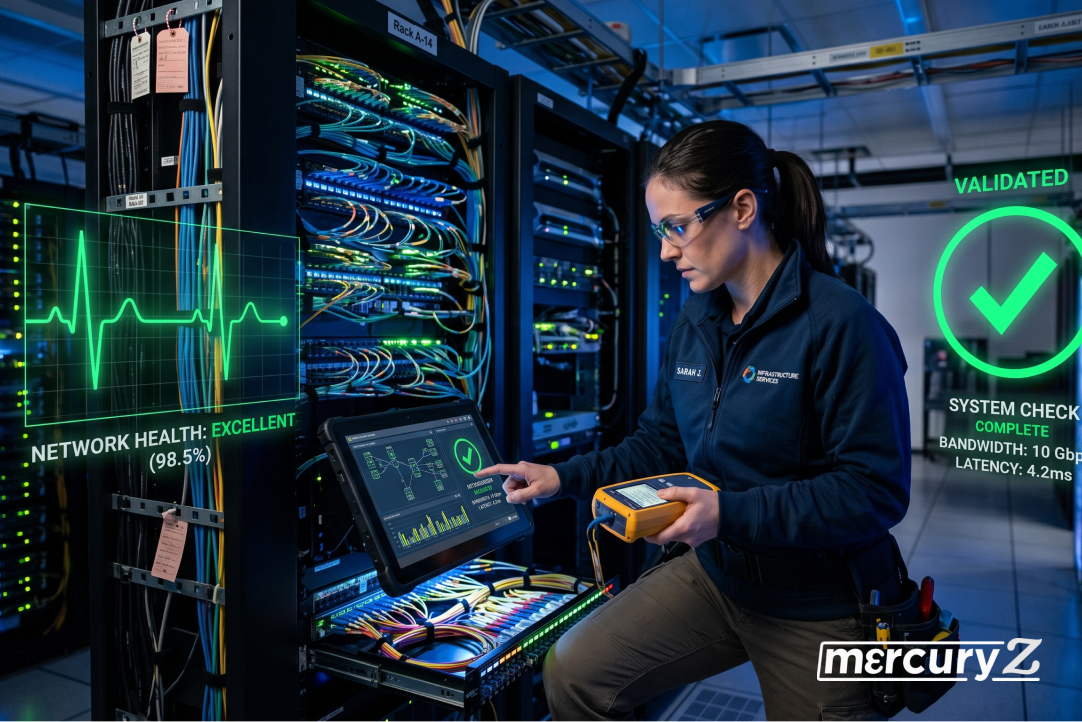
As telecom, hyperscale, and enterprise networks continue to expand, maintaining accuracy between physical infrastructure and digital records has become increasingly complex. Over time, networks evolve through upgrades, mergers, maintenance activities, and emergency restorations. These changes often create inconsistencies between documentation systems and the actual fiber plant. This condition, commonly referred to as network drift, creates operational inefficiencies, delays provisioning, and leads to underutilized infrastructure. In 2026, this challenge is even more critical. The growth of AI workloads, hyperscale data centers, and high-capacity optical transport requires precise visibility into fiber infrastructure. Without accurate network intelligence, organizations risk overbuilding capacity, misallocating resources, and increasing operational costs. Fiber auditing and network health validation services address these challenges by restoring alignment between physical assets and digital records, enabling operators

Read More »

DWDM & Optical Transport Engineering

The modern digital ecosystem is expanding at an unprecedented pace. From AI-driven analytics to hyperscale cloud infrastructure and 5G expansion, providers are under immense pressure to deliver higher capacity, lower latency, and improved reliability. Traditional fiber transport methods, while foundational, are no longer sufficient to handle today’s bandwidth-intensive workloads. Organizations now require advanced optical transport solutions that maximize fiber efficiency and support scalable growth. Dense Wavelength Division Multiplexing (DWDM) has emerged as the backbone technology for high-capacity networks. By enabling multiple wavelengths to transmit over a single fiber pair, DWDM dramatically increases throughput without the need for additional physical infrastructure. In 2026, this capability is more critical than ever, as enterprises, telecom providers, and hyperscale operators race to support AI workloads, cloud interconnectivity, and global

Read More »
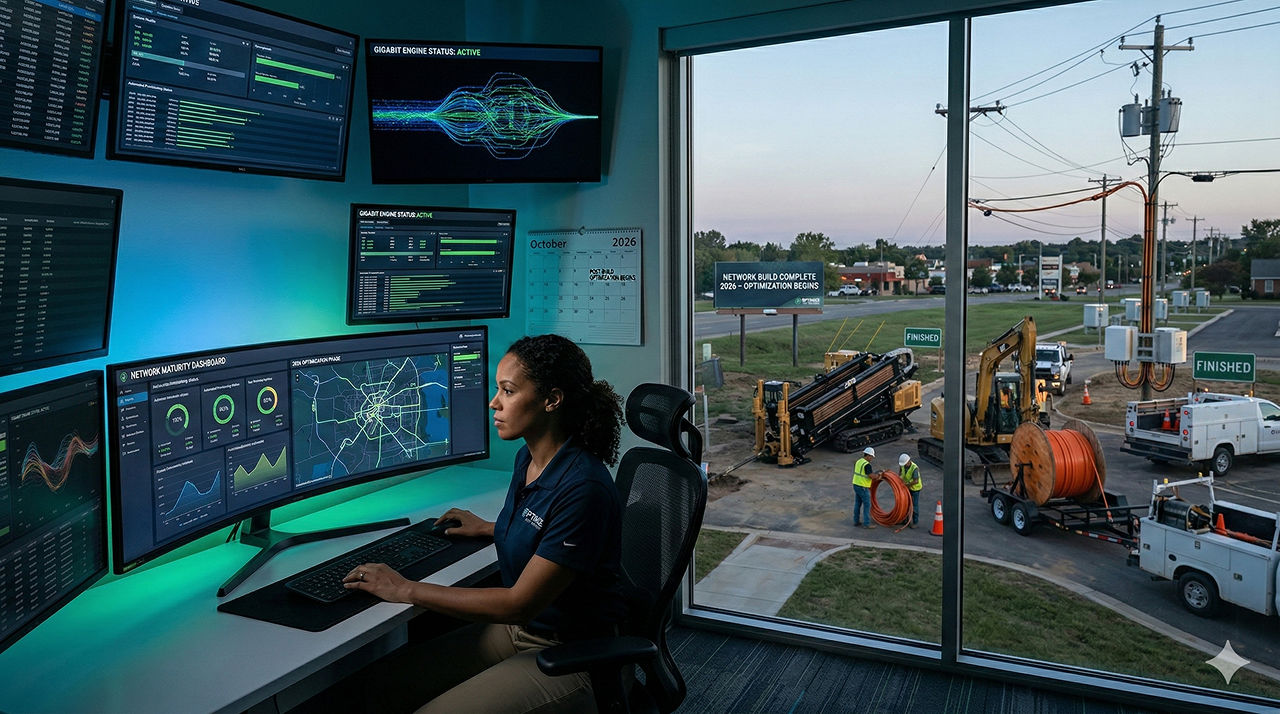
An ISP operator in a modern control room conducting network infrastructure optimization on digital dashboards, contrasted against construction trucks completing fiber installation visible through a large window.

Future-Proofing: Transitioning from Build-Out to Optimization

For the last several years, the telecommunications industry has been defined by the “Great Build-Out.” High-visibility construction crews, massive rolls of orange conduit, and the frantic race for fiber-to-the-home (FTTH) have dominated executive agendas and capital expenditure reports across the globe. Specifically, this era of physical expansion was driven by a singular goal: to plant the flag and claim territory in the high-speed race. However, as the dust finally settles and the physical glass reaches maturity in market after market, a sobering question emerges for leadership: What happens when the construction trucks leave? Ultimately, the completion of a physical network is not the finish line—it is merely the starting block for a much more complex race. Consequently, once the hardware is in the ground, the

Read More »
A field technician using a secure tablet to manage network security, ensuring BEAD cybersecurity compliance at a rural edge cabinet and tower site.

BEAD Cybersecurity Compliance: Securing the Edge for Modern ISPs

BEAD cybersecurity compliance is now a top priority for every mile of fiber laid. Every new subscriber connected is a win for digital equity. However, in the eyes of a cybercriminal, that new infrastructure represents a fresh attack surface. As regional ISPs and cooperatives rapidly expand into unserved territories, they are no longer “too small to be noticed.” In 2026, rural networks have become prime targets for ransomware groups. These hackers bet on the fact that smaller providers may lack the sophisticated defenses of national carriers. Furthermore, the NTIA’s official BEAD guidance emphasizes that security is a pillar of the program. When you’ve just spent millions on a build-out, you cannot afford a network-wide freeze. Such an event erodes customer trust on Day 1. The

Read More »
An infographic illustrative of the "Day 2" Problem for growing ISPs, featuring a stressed IT team in a dark modern NOC. They are analyzing multiple screens displaying prominent red alert icons. Through a massive window, a sprawling city is overlaid with a digital fiber network. Digital overlay text at the top reads: "The 'Day 2' Problem: You Built the Network, Now Who Runs It?" This image highlights the risk of scaling infrastructure without robust ISP NOC Services

Why Your Expansion Needs Proactive ISP NOC Services

To survive rapid expansion, providers must implement scalable ISP NOC Services. A regional ISP doubling its footprint cannot handle modern ticket volumes with a small five-person team. You need dedicated technical support to maintain your reputation during this growth. You did it. The fiber is in the ground. You checked every BEAD compliance box. Thousands of new subscribers are finally coming online. But as you flip the “On” switch, the relentless ringing of support lines fills your office. At this moment, a lack of infrastructure management becomes a critical failure point. Expanding ISPs often encounter the “Day 2” Problem. You built a 2026-grade network, but you still use a 2020-grade support team. Ticket volume scales exponentially when your footprint doubles. Suddenly, your team is underwater.

Read More »
An aerial view of a busy port and logistics hub is shown, featuring countless shipping containers, multiple trucks, and a network of raised highways with moving traffic. Floating, transparent holographic screens with graphs, a world map, and data points are linked together by light beams. A large digital title screen in the background reads, 'BOOTS ON THE GROUND: MANAGING THE LOGISTICS OF MASSIVE DEPLOYMENT', with a subtitle 'YOU HAVE 10,000 LOCATIONS TO CONNECT IN 24 MONTHS. HOW DO YOU MANAGE THE CHAOS?'.

Mastering Broadband Deployment Logistics for Massive Fiber Projects

The ink is dry on the grant and the funding is in the bank. Additionally, your engineering team has handed over a stack of precision blueprints. For many ISPs and cooperatives, this is the moment where excitement meets a cold reality. Specifically, the broadband deployment logistics of a massive build are a battlefield rather than a simple task. Connecting thousands of unserved locations across rugged terrain is a massive feat of coordination. In fact, it would challenge a military general. You are not just laying cable. Instead, you are managing an ecosystem of splicing teams, installers, and safety auditors. Furthermore, you must navigate unpredictable weather, supply chain delays, and local permitting. Navigating the Logistics Trap: Why Standard PM Isn’t Enough In a typical deployment, a

Read More »

OSP Engineering for Broadband Deployment: Your First Line of Defense

In the high-stakes race to bridge the digital divide, the most expensive mistakes occur on paper rather than in the field. For ISPs and cooperatives, mastering OSP engineering for broadband deployment is no longer a luxury; instead, it serves as the primary tool for financial survival in a market where every cent of grant funding faces intense scrutiny. Featured Snippet Optimization: Successful broadband deployment relies on high-quality OSP engineering to mitigate risks like permit rejections and unforeseen make-ready costs. By utilizing GIS data and Scalable Engineering models, providers can scale their network design phase efficiently. Consequently, this ensures that construction crews avoid costly field changes and stay within BEAD grant budget constraints. The 1-10-100 Rule of OSP Engineering for Broadband Deployment In the telecommunications world,

Read More »
Precision fusion splicing for hyperscale fiber installation addressing the BEAD labor deficit.

Bridging the BEAD Labor Deficit: Scalable Workforce Solutions for Broadband Deployment

The Shifting Frontier of U.S. Infrastructure As the government releases BEAD funding, the era of “Grant Acquisition” is officially ending. Consequently, the scramble for grants is transitioning into a high-stakes race for execution. Billions in federal capital are now flowing to states, ISPs, and municipalities. However, these awardees are slamming into an unforgiving reality. We are entering a period where capital is abundant, but the human resources required to build these networks remain scarce. Both the National Telecommunications and Information Administration (NTIA) and the Government Accountability Office (GAO) have identified workforce availability as the single greatest risk. To solve the BEAD labor deficit and meet rigorous timelines, stakeholders must take immediate action. Furthermore, reports from the Department of Commerce Office of Inspector General estimate the

Read More »